Telepathy and The Psychic: Two Movements of Thought
I must be clear about the distinction between the two.
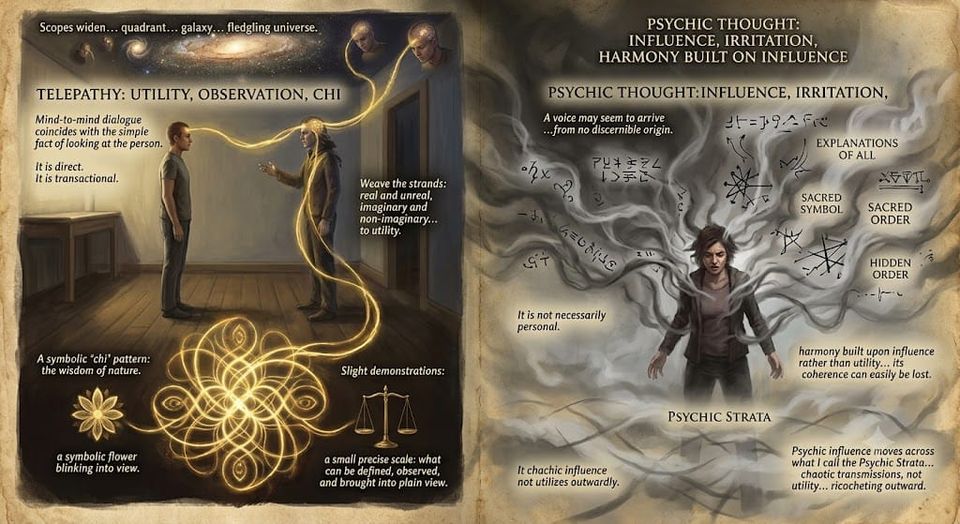
Telepathic thought is primarily a matter of point of view. I see who the person is. At a localized level, if I do not see the person within my field of view, then it is someone I personally know—and my mind registers, without question or complaint, exactly who the contact is.
There is no need for a name or identifying signature. There is no doctrine, no hidden agenda of religion or spirituality pressing itself upon the contact.
It is direct.
It is transactional.
For me, telepathy often takes the form of movement: I am leaving here. I am arriving there. The distance between these is measured in abstract time. Yes, sometimes the exchange opens into philosophical discussion, but even these discussions remain local. I know, within my personal life, who I am in contact with.
For deeper lucidity, the experience reaches its clearest expression when mind-to-mind dialogue coincides with the simple fact of looking at the person standing before me.
At such moments, reality itself bridges perception and connection.
You are in conversation with the mind while simultaneously in dialogue with the actual person. When the two converge, it becomes a miracle of reality—an event beyond mere thought, something experienced as truth within the living moment.
But psychic thought is different.
Psychic thought is about influence.
A voice may seem to arrive from a million miles away—or from no discernible origin whatsoever. It may appear to speak from a divine source, or carry with it the tone and authority of divinity, but its essence is not necessarily personal, and it is not necessarily local.
Influence is what travels.
Transaction remains local.
Psychic influence moves across what I call the Psychic Strata, like transmissions bouncing from the stratosphere, ricocheting outward to discover where they might land.
This is where the psychic resides: in influence.
And for me, this is often where the irritation begins.
Psychic thought frequently carries with it the claim of divine understanding: explanations of how everything works or does not work, what must be done for you, what must be done for them, what this symbol means, what that character represents, what hidden order supposedly binds the whole of existence together.
Yet these claims may arrive without any discernible record in reality.
They may be filled with explanations, symbolism, characters, and elaborate relationships between those characters. To those under the influence, these things may appear to form a perfect harmony. Yet because that harmony is built upon influence rather than utility, its coherence can easily be lost.
There may be nothing describable.
Nothing observable.
Nothing held.
Telepathy, by contrast, seeks what can be recorded, defined, observed, and brought into the plain view of perception.
The telepath, at this level of his journey, must therefore learn to look above and beyond himself.
His path is evolution.
The movement of his path is observation.
Telepathic reality cannot remain restricted to the binary of imaginary or unimaginary, real or unreal, conceivable or inconceivable. Rather, the realization of the telepath is to discover the connective thread running through all the relationships he experiences—and then to observe whether reality demonstrates anything corresponding to his projection.
This requires diligence.
It requires clarity.
In time, the telepath learns to weave the strands together: the real and the unreal, the imaginary and the non-imaginary, the conceivable and the inconceivable.
And from this weaving there begins to emerge a coherent thread of thought, expression, demonstration, and utility.
Not influence.
Utility.
And within that weaving arises something that might easily be mistaken for force.
I call it chi.
Chi is the wisdom of the cosmos expressed through the pattern of its own nature. Nature is what brings this wisdom toward harmony.
The telepath plays an integral role in pronouncing that nature into slight demonstrations: small proofs, subtle unveilings, moments in which something previously hidden becomes observable.
Through understanding—not through narrow-mindedness—he learns to channel this wisdom.
When the telepath is able to determine and deeply comprehend the nature of something, there may come a moment when that understanding appears reflected directly within reality. Something blinks into view. Something manifests before perception. It appears for observation, for discernment, and, when the relationship proves meaningful, it becomes the beginning of evolution.
This is the work of a lifetime.
The telepath may refine his chi to such an extent that even the body itself becomes part of this investigation. When the body is reduced to mere logic—serving only desire, want, fear, or security—the master seeks to dissolve that narrow logic by channeling chi into the event.
This is the work of the true master:
the body brought back into the wisdom of its own nature.
And when the telepath dies naturally, the question becomes whether the chi refined through a lifetime of observation continues in some form—whether what has learned to observe continues to observe.
The scope widens.
From individual,
to planet,
to quadrant,
to galaxy,
to fledgling universe.
And somewhere, in the dark, some demon of chaos blinks.
In that instant of awakening, the chi—the wisdom of nature itself—kindles the possibility of a new universe.




Member discussion