The Light and Dark
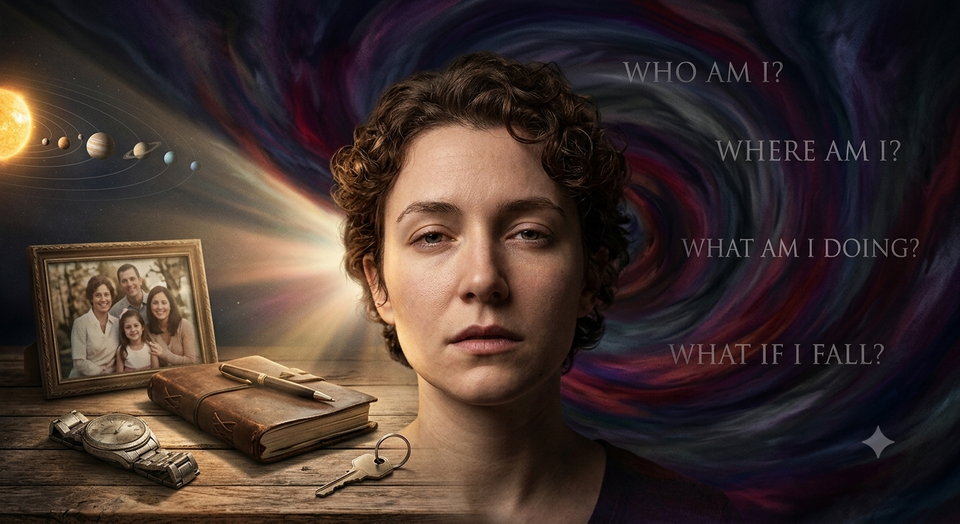
I would like to take a moment and talk about what this is—light and dark—and how a life can be ruined by it, lol.
If I close my eyes, what is this? Is this darkness?
The answer is no. This is saturated color, and there is even a name for it.
Now I open my eyes and see the world in front of me. I have seen it numerous times. So then, if I close my eyes and have irrefutable faith in letting go of the senses, how far can I walk without this simple opening which is sight? The same is true with the others.
Faith would be the ability to continually walk in a straight line without my eyes being open. I can have faith in myself so pure that I do not need any sense at all to continue.
But the eye opens out of imbalance.
The noticing of myself as movement alone.
This wall in the dark appears and—bam—I open my eyes. Not because of what I see or what I don’t, but because the questions arrive:
Who am I?
Where am I?
What if I fall down?
These are all questions of imbalance.
And when there is imbalance, am I to expect another sense to arrive other than sight to clarify this?
The answer is no.
There is no other sense arriving to answer:
Who am I?
What am I doing here?
Am I about to fall down?
So the suggestion here in the psychic strata—that another sense has arrived to answer these questions of imbalance beyond what the senses have already determined—is false.
Saying it again:
My eyes are open. I move forward. And still these same questions that caused imbalance in the dark remain:
Who am I?
What am I?
Where am I?
What am I doing?
And these are not going to be answered psychically either—especially in a place where they had not been answered before entering it.
Think of it this way:
My eyes are closed. I am not asking anything of imbalance to my movement. But the moment I think I may have entered another room, another condition, another unknown place, those same questions of imbalance begin to arrive again—and wham—my eyes open once more.
Not because sight revealed truth.
But because imbalance demanded resolution.
That is the deeper problem with light and dark.
Darkness is not merely the absence of sight. Darkness can be assumed as a saturation of a color which leads to an arising of imbalance. And light is often not understanding either—it is simply a confrontation against imbalance.
Light is confrontation. The light exudes from the sun and it bam confronts the planets. The planets about their what imbalance notice the relationship between the sun and planets how light coming from the sun the sun itself keeps the planets in orbit the planets are an imbalance kept in balance by the light. Te utter balance is nothing or the silence of it all the stillness of it.
This is how lives become ruined by these things.
Because one begins to believe that what emerges in the dark—that voices, psychic impressions, unseen presences, strange conclusions—must somehow answer the imbalance itself.
But they do not.
They circle it.
The same questions remain underneath all of it:
Who am I?
Where am I?
What am I doing?
And if these questions are unresolved before entering the psychic space, they remain unresolved within it as well.
The eye opens.
The mind grasps.
The imbalance continues.
And then one mistakes the movement toward reassurance for revelation.
Other than all of this is to operate in complete faith.
In complete faith, in order to achieve a perfected state with this, is faith to let go of who you are, what you are, what you are meant to be. These statements—almost accusations themselves—cause the imbalance. They suggest an eye needs to be open when I am suggesting: do away with all of it if you are truly seeking that perfection.
Notice in your life that you are surrounded by objects of light.
What do I mean by this?
I am stumbling in the dark. The questions of imbalance arrive. I open my eyes—and there they are. All of my possessions. They seem to keep me in balance with who I am. In fact, the more awkward the imbalance, the more it would seem to suggest the greater my need for possessions to stabilize me and my behavior. This brings up the question of perfect balance in life.
Objects of light—do you understand this?
That the possessions in your life are objects of light.
For shut your eyes and you are in darkness, but open them and there they are.
Now I see you would suggest that in darkness these objects still exist, but to bump into them—would that not itself be a clue to your balance, to where you are standing, even while in darkness? This object you have stumbled upon in your own room is still an object of light, thereby giving you a clue to the questions of imbalance. You have balance to your movement.
Then you open your eyes—and there they are again, giving you balance.
As I have said, these objects are also fear. Because with or without them you will still be imbalanced if your mind itself is not in balance.
Comically put, to walk in the dark and now harm your foot on one of your own objects would become something to fear in the dark. Then you open your eyes and there they are again, giving you balance. So whether in the dark or in the light, you are in fear with them or without them. The object itself represents fear—for when you bump into it, you fear it, and only when you give it guidance as to where it belongs do you no longer fear it in the same way.
The same understanding applies to people as well.
Now to proceed to the next understanding—what would be a higher realization of this?
Imagine now that you are free of possessions. You are sitting in a place, perhaps a meadow. Would it not be easier to walk in a straight line there with your eyes closed? At least slightly less difficult for the mind to wander into these questions:
Where am I?
Who am I?
What am I?
What am I doing?
Have I lost my balance?
Then the forces around you—the movement of the wind, the warmth of the sun—you would still be given sense-thought, wouldn’t you?
The sunlight would suggest:
I am warm.
I am outside.
I am beneath the sun.
And so I learn about my environment through these senses.
But what if those are shut off as well?
Before I go further, understand the state you are now in without possessions—or at least with the understanding of them removed—is a state of wonder.
Now the senses are removed, yet I am still in movement. Therefore, the question of balance arises once more:
How am I to move with balance?
I would state:
In complete faith and wonder.
Not through identity.
Not through possessions.
Not through the reassurance of light.
But through the relinquishment of needing to know what you are while still remaining in motion.
This is where people become frightened.
Because the mind wants an object to orient itself around. A wall. A possession. A title. A face. A purpose. Something to open the eye toward and say:
“There. That is what I am.”
But complete faith dissolves this need.
And in that state, one does not move because they know.
One moves because they are.
Member discussion