The Man, Woman and their Children
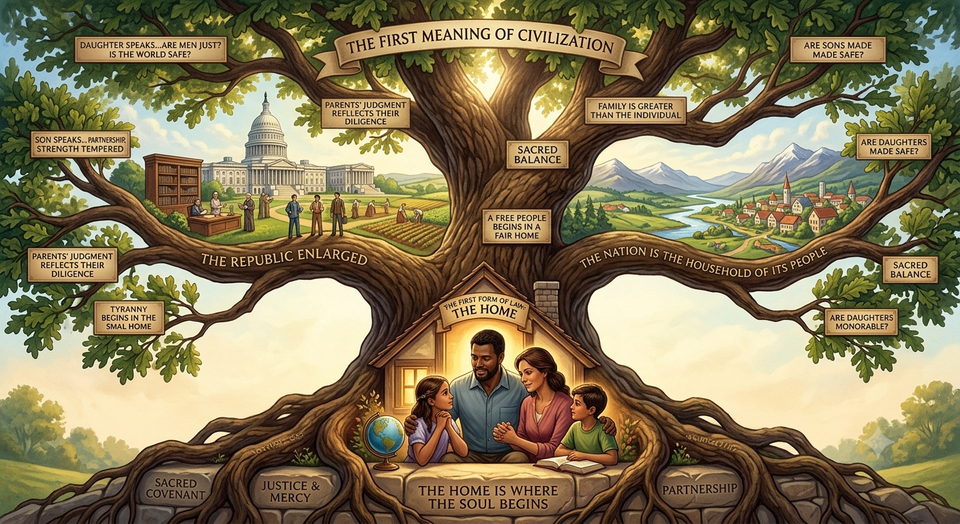
We can find the foundation of law and government in how a father and mother handle their children through the years of their childhood. Their sense of justice toward them—how they teach, discipline, forgive, and reward—deeply reflects their acceptance and diligence toward the law of their nation. If the parents are fair, measured, and merciful, then the children grow in the likeness of a free people. But if they rule by fear or neglect, so too will their nation falter, for tyranny begins in the smallest home before it reaches the highest office.
The relationship between the man and the woman, and their children, is sacred. It is not merely domestic. It is not merely private. It is the first form of law, the first school of justice, the first nation a child ever enters.
The home is where the son and daughter first discover whether the world is ordered, whether love has discipline, whether strength has mercy, and whether freedom has responsibility. Before a child ever speaks to the Republic, before they ever stand before the law, before they ever become a citizen among citizens, they first stand before the father and the mother. And in that sacred arrangement, the first meaning of civilization is revealed.
The daughter speaks to her father in a particular way. Not always for comfort alone, and not always for instruction she can fully comprehend, but to hear his philosophy, his ethic, his principle. She asks questions that may even be outside her intellect or her present understanding because, in truth, she is testing the world through him. She is asking whether the world is safe for daughters. She is asking whether men are just. She is asking whether power can be moral, whether strength can protect without possessing, whether law and order are made only for sons, or whether they are also made for daughters to walk safely beneath the sun.
The son, on the other hand, speaks to his mother so that he may see a woman—not as an idea, not as a conquest, not as an object of desire, but as the woman who chose his father, the woman who helped make the home possible. For the son who speaks only to his father may seek only to become his father. And while there is honor in that, there is also danger. The son may mistake manhood for solitary striving. He may believe that his father’s strength came only from himself, when in truth the strength of the father was tempered, focused, and completed by the woman beside him.
The mother on the other hand teaches the son that a man’s vision of himself can become fruitless without the wisdom of a woman to meet him. She shows him that the home did not arise from the sole interest of a man discovering himself, but from partnership. The house he lives in, the order he trusts, the life he has been given—all of it comes from the union of his parents. And in seeing his mother rightly, he begins to understand what kind of woman he should seek, and what kind of man he must become to be worthy of such a partnership. A Man’s true strength lies in the strength of his home.
This is why the family is greater than the narrow vision of the solitary individual. To pursue only what one thinks one is supposed to be, apart from the home, apart from family, apart from the sacred responsibility of relationship, is not equal to the strength discovered in the family itself. The individual alone may gain power, pleasure, or identity, but without the woman this vision can bend toward hedonism. Without the man it may become illusion without structure. And without the children, it can become meaningless, for children are the force that carries meaning through time.
The father, the mother, the son, and the daughter each reveal a different law of the home. The father shows the daughter whether strength is safe. The mother shows the son whether love has wisdom. The daughter reveals to the father the moral burden of his power. The son reveals to the mother the future of the man he is becoming. Together, they form a sacred balance: justice and mercy, strength and nurture, protection and freedom, individuality and responsibility.
As the man shoulders his duty, so the Republic must bear the weight of its promise.
As the woman gives nurture and wisdom, so the Republic must offer compassion and care to its people.
As the child learns from both, so the citizen learns from the harmony of justice and mercy.
For the Republic is not separate from the home. It is the home enlarged. The nation is the household of its people, and its laws are tested by the same sacred question: are the sons made honorable, and are the daughters made safe? Does strength serve love? Does freedom serve responsibility? Does justice protect without possessing? Does mercy nurture without weakening?
A nation that forgets the sacredness of the family forgets the first architecture of civilization. But a nation that remembers the father, the mother, the son, and the daughter remembers the original covenant of law: that power must be moral, love must be responsible, freedom must be disciplined, and the future must be protected.
For the home is where the Republic first learns its own soul.




Member discussion