The New American Creed
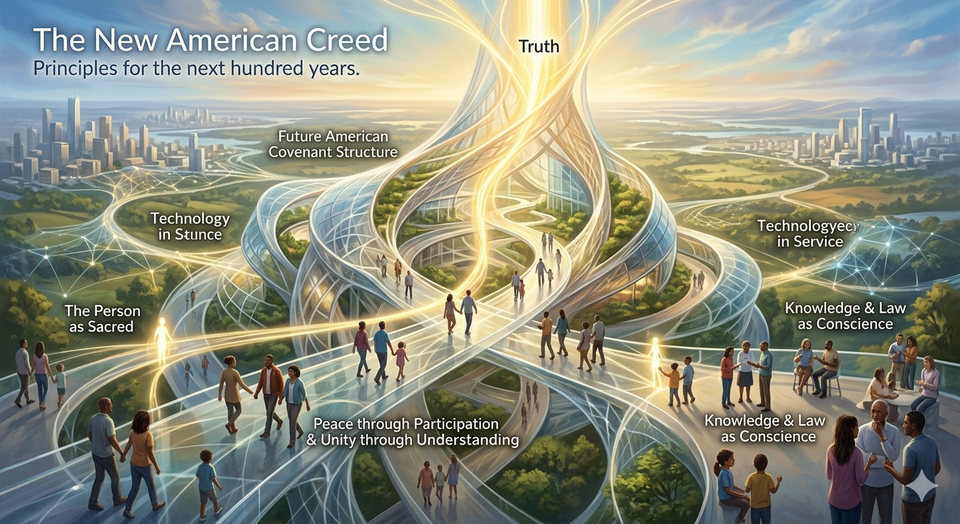
The New American Creed
Principles for the next hundred years.
Every century demands its renewal of faith. The words of the past remain sacred, but the spirit must be spoken anew. The American experiment, once born from ink and courage, must now be reborn through consciousness and clarity—not as a rejection of the old, but as its continuation into a higher form of understanding.
The New American Creed is not a political platform; it is a spiritual declaration. It seeks to remind the nation that liberty is not sustained by law alone, but by character—that democracy is not a structure, but a state of mind. As the world transforms—through technology, through communication, through revelation—the principles of the Republic must deepen, not dissolve.
Let this be the creed of the next hundred years:
1. Truth before tribe.
That truth stands above allegiance, and that no party, system, or ideology may claim ownership of it. The measure of patriotism is not obedience, but honesty.
2. Liberty through responsibility.
That freedom is not indulgence, but stewardship—the discipline to govern oneself so that all may remain free.
3. Knowledge as moral power.
That education is sacred work, and that the pursuit of understanding is the defense of democracy itself.
4. Technology in service of humanity.
That innovation must expand consciousness, not replace it; that progress is measured by wisdom, not speed.
5. The person as sacred.
That every human being is an end, not a means; that personhood—not profit, not property—is the true unit of civilization.
6. Law as the instrument of conscience.
That justice must reflect moral truth, not merely order; that authority exists to uphold virtue, not vanity.
7. Peace through participation.
That civic engagement is not a duty of convenience but of devotion; that democracy sleeps when its people grow silent.
8. Faith in the unseen good.
That the divine still breathes through freedom—that Providence, though hidden, remains the unseen ally of a just people.
9. Unity through understanding.
That the Republic is not a uniformity of belief, but a harmony of differences bound by mutual respect.
10. The mind as the final frontier.
That the evolution of democracy now depends on the liberation of consciousness—the awakening of each citizen to their role as a sovereign of thought and a keeper of truth.
These are not commandments, but coordinates—a map toward the next horizon of liberty. They call upon every American to reclaim their part in the moral architecture of the Republic: to think clearly, act justly, create boldly, and believe that the nation is not finished but still being written.
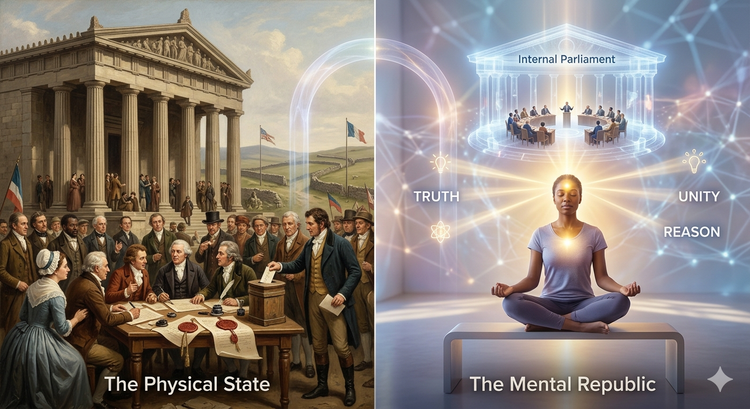
The first revolution gave us independence of body; the next must give us independence of mind.
The world will not remember America for what it conquered, but for what it understood—
that freedom is the soul’s natural state,
and that truth, once seen, must be lived.
This is our inheritance. This is our charge.
This is the New American Creed.
Be the Revolution
 Chase McQuade (Author) Format: Paperback


Member discussion