The Principals of a Telepathic Society
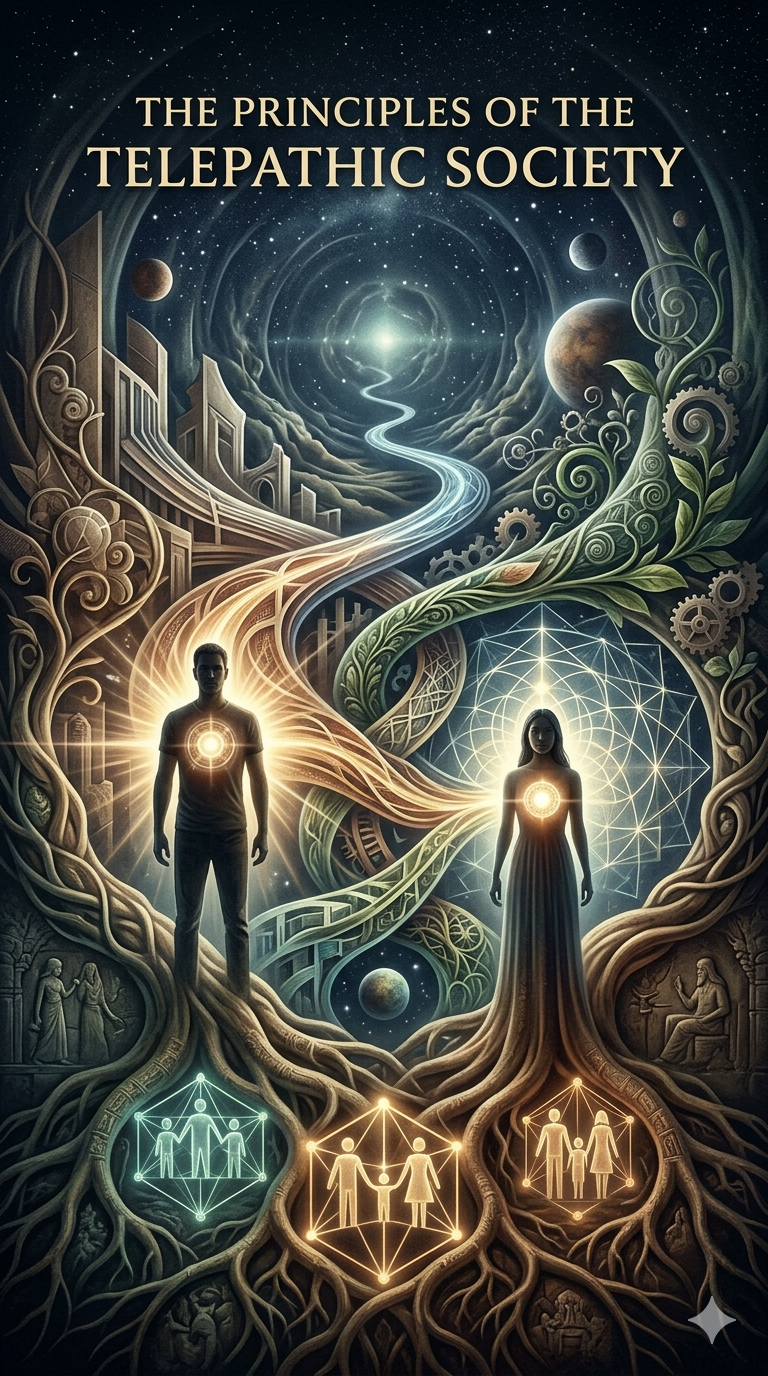
The Principles of the Telepathic Society
- The Telepathic Foundation is the Family
The first architecture of telepathy is not the state, nor the institution, nor the individual.
It is the family.
Not merely the family one creates, but the family one emerges from. The psychic structure of a telepath is formed through origin, relationship, responsibility, hierarchy, affection, consequence, and continuity. A true telepath emerges from a living moral structure before they ever emerge into the wider world.
The family teaches the telepath how to answer themselves.
It teaches boundary, reverence, accountability, and emotional proportion. Without this foundational architecture, telepathy risks becoming untethered from human continuity and collapses into abstraction, ego, or psychic self-interest.
If one claims telepathic insight yet possesses no devotion to family, lineage, or continuity, then their telepathy often becomes rootless—detached from the living conditions that give psychic insight moral orientation.
The telepath must emerge from somewhere real.
- The Telepath is the Center of Their Awareness
A telepath does not dissolve themselves into others.
Awareness remains centered.
The moment a telepath claims their awareness permanently inhabits another person, or that their existence is located primarily within someone else, telepathy begins to collapse into deillusion.
The telepath may perceive, empathize, resonate, or recognize—but they do not abandon their own center of awareness.
Without a center, there is no clarity.
Without clarity, there is no telepathy.
- The Telepath is Dedicated to Movement
A telepath must move with life.
Song, dance, architecture, engineering, botany, finance, construction, philosophy, invention—these are not distractions from telepathy. They are its manifestation.
Telepathy is not merely thought.
It is participation in the movement of reality.
A stagnant telepath becomes consumed by psychic recursion. A moving telepath transforms insight into structure. Through labor, discipline, craft, and innovation, the telepath aligns themselves with the currents that move through time itself.
- Telepathy is Not Self-Development
The telepathic path cannot revolve around self-glorification.
The moment telepathy becomes centered on “my growth,” “my power,” “my awakening,” or “my superiority,” it begins collapsing into psychic distortion.
Others are not instruments for the construction of the self.
This is not telepathy.
This is deillusion.
True telepathy moves toward coherence, mutual refinement, innovation, and shared construction—not narcissistic expansion disguised as spirituality.
The telepath contributes to something greater than themselves.
- Reading Minds is Not Telepathy
Mind-reading is not the highest form of telepathy.
In fact, obsession with the contents of another person’s mind often destroys telepathic coherence altogether.
True telepathy is based on autonomous development.
Two telepaths separate from one another and continue building what is inherent to themselves. When they reconnect, they do not cling psychologically to one another—they exchange innovation, architecture, realization, movement, refinement.
The focus is not possession of thought.
It is the construction of reality.
When telepathy becomes centered on attachment, emotional dependency, dominance, weakness, or psychological ownership, it suffocates both participants.
But when telepathy is centered on shared creation, then thoughts cease orbiting personalities and begin flowing into architecture, invention, beauty, civilization, and continuity.
- A Telepath Must Possess a Genuine Interest in Life
Telepathic strength mirrors one’s dedication to life itself.
A telepath must love something real.
A craft.
A discipline.
A form of study.
A responsibility.
A living pursuit.
If a telepath’s psychic insight exceeds their dedication to actual living, stagnation begins. Their awareness collapses inward and eventually becomes oppressive—to themselves and others.
But where strong dedication exists, telepathic clarity strengthens alongside it.
Even cunning has its proper place.
Cunning in music.
Cunning in engineering.
Cunning in botany.
Cunning in governance.
The telepath recognizes that innovation itself reveals the health of the commune.
Where no one builds, refines, studies, risks, or creates—telepathic life begins to decay.
Thus the telepath must remain connected to living reality through meaningful work, disciplined interest, and authentic participation in existence itself.
7. The telepath must originate from a body.
If it doesnt then it becomes parasitic inclusion.
8. Where does telepathy reside. Is it within a or is it outside.
The mailbox the internet the car is in the garage that leaves
this world signify to me in a everyway that the thought of someone leaves the mind into the world the question is always through which medium.
So how does this happen the way we communicate.
Alright beautiful listen this is early stuff
Telepathy, in this sense, is not arbitrary.
It is not simply one mind reaching into another. It is not for my advantage, nor for the advantage of someone else. The connection itself has reason, structure, alignment. To discover why two beings become connected—that is the true mystery.
In one sense, it resembles an exchange between a customer and a seller, something almost physical in nature. There is movement. Reciprocity. Convergence. But if telepathy is reduced merely to personal development, then its greater architecture remains unseen.
See all lives as conduits—like tunnels.
Your life possesses a consciousness to it. The events you experience, the thoughts you carry, the suffering you endure, the disciplines you cultivate—these form the walls of the tunnel itself. And when your life aligns with another’s, whether here, elsewhere, now, in the past, or perhaps even beyond this world, a connection occurs.
Not randomly.
But through correspondence.
Consider even the possibility of those outside this planet. How would your life, your experiences, your exact moment of realization align with another intelligence elsewhere unless there existed some deeper regulation, some architecture of convergence already woven into existence itself?
And because telepathy is not arbitrary, you can look through scripture, myth, and history and begin to see why certain figures continue to echo through humanity across time.
Take the Buddha, for example.
He discovered suffering—not merely as a personal condition, but as a universal connective principle. He encountered something all beings share. And because he found not only suffering, but a way through it, his realization became a permanent connection point within human consciousness.
That is why, even now, you hear the Buddha.
His realization continues to resonate because it touched something inherent to us all.
And perhaps the same can occur elsewhere.
A person may discover another universal principle—something overlooked, something foundational, something tied to existence itself—and through that discovery create another enduring point of convergence within consciousness.
But there is danger here as well.
For if your awareness aligns itself with destruction, domination, or collapse, then you may begin resonating with those same forces throughout history and myth. You may suddenly understand why figures associated with destruction, judgment, or dissolution emerge within human consciousness again and again.
Perhaps this is why Shiva appears—not merely as a deity, but as a realization connected to destruction, transformation, and the terrible necessity of endings.
And perhaps one day you encounter that same threshold yourself.
Hopefully with humility.
Hopefully without arrogance.
Hopefully with enough ignorance remaining within you that you do not mistake your encounter with the infinite for ownership over it.
This, too, was something the awakened ones understood.
But return now to the beginning.
Can you discover something that lasts?
Something meaningful enough to move through time itself?
Something that supports life, clarifies existence, or reveals a hidden principle no one has properly articulated before?
And if you do—what then have you encountered?
A new god?
An old one rediscovered?
An awakening?
Or merely another dream within the architecture of consciousness?
Much has already been explored by those who dedicated their lives to these questions. The ancient minds, the mystics, the philosophers, the saints—they have already traveled deep into these tunnels of convergence.
And one lesson appears repeatedly:
“Unto another” and “unto myself” are not simple distinctions.
Because the moment telepathy becomes centered entirely upon another person—or entirely upon oneself—it begins to turn inward dangerously. The realization itself eventually asks:
“Unto you… or unto myself?”
And if one is not equipped with immense foresight, immense responsibility, and a deep reverence for consequence, they may begin using the lives of others merely as extensions of their own becoming.
That is not awakening.
That is consumption.
The true telepath understands that every realization carries consequence—not only for themselves, but for countless others whose lives may become entangled with that realization across time.
Catch the Sensation
Glamour and Truth



Member discussion