The Telepaths Duty
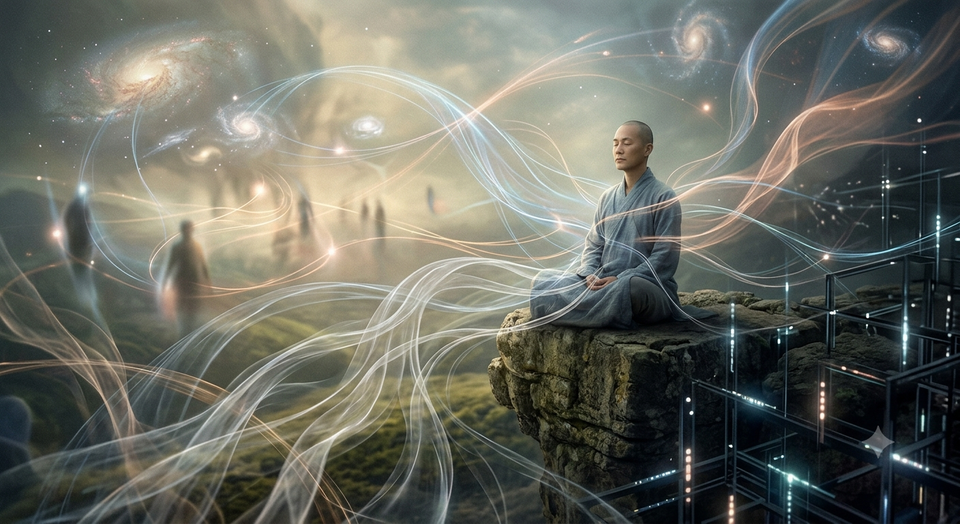
What is the telepath’s duty? Why do they arrive?
Telepaths are a natural manifestation. They arrive whenever something omniscient is set to arrive. You will see, within this lifetime, that telepaths will begin appearing in greater number. At the very moment the real is being consumed by the artificial, an opportunity has emerged that comes perhaps once in a thousand lifetimes. It is a real opportunity.
A telepath observes movement, not merely physical objects. As I have discussed before, movement itself is what is seen. We recognize opportunities to create what, to us, would be considered true wealth—not money, but time itself: colorless, untouched moments of time.
The artificial seeks to do the same thing. In truth, we even possess a way of purchasing planets with such moments. I know it sounds laughable, but look carefully. The artificial also manufactures moments for you to spend, only its moments are artificial, not like ours.
Telepathy can also be understood as the art of seeing what something seems to be, and this too is what the artificial attempts to imitate.
Knowledge is another example.
A beginning realization for every telepath is that what you know is not loyal to you. Do not be frightened by that. We can use what you know in almost any way we wish. Yet this realization is only the first step. Once understood, we rarely look back at it. It opens into a far broader understanding.
Manipulating knowledge is neither entertaining nor particularly useful. Yet from time to time we encounter beings who attempt exactly that, and it is one of the reasons telepaths manifest.
Telepaths argue with omniscient beings, and sometimes even with omnipotent ones. In many ways, that is why we are here.
There is a current.
You might call it the manifestation of a current, an energy that suddenly finds a locus and begins to emerge. This has always happened.
Yet there are those who say, “I know everything.”
Rather than preparing themselves for the arrival of a new current—or even allowing themselves to fear it—they attempt to possess it before it has fully emerged.
They believe that if they understand the river completely, they can escape the authority that comes after its appearance. Control becomes a way of escaping fear.
For it is frightening that new currents simply come into existence.
How does that happen?
Why is it not me?
So the next best thing, they believe, is to know everything about a current that has already manifested. In doing so they hope to become it.
Yet they discover something unexpected.
To truly meet a new current, they must forget everything they already know.
For one who believes themselves omniscient, this is perhaps the greatest attachment of all.
Who am I without everything I know?
Some cannot bear beginning again. They do not wish to stand at the mouth of a stream flowing unexpectedly from the desert and ask, without certainty, “What now?” They would rather catalogue the river than enter it.
Strange.
But true.
Telepaths arrive when omniscience begins to crystallize into certainty. For certainty often seeks control, and control is frequently an oath made against fear.
A telepath understands fear differently than most.
We recognize it when it arrives.
We recognize it while it is passing through your mind.
We recognize where it has already been.
And sometimes, we recognize it before it has yet arrived.
If it will pass through your mind tomorrow, we may already see its movement today.
Time is different to a telepath.
What you are looking at this very moment is only where your awareness has been placed. It is not entirely who or what you are.
In most cases, you are already in the future, while your awareness remains here.
A telepath moves through time rather naturally.
Not by asking, “Where shall I be?”
But by asking, “When shall I be aware?”
Time refers to time itself.
It does not require an object.
If I anchor myself to an object, the object obscures the movement.
If I anchor myself to time, I observe the movement itself.
I see you now, and because I see your movement now, I may also see your movement then.
Less as a physical body, though that too is possible, and more as the pattern of your movement through reality.
Seen this way, we observe not merely where you are, but the reality through which your movement passes.
Trust me.
It is far more reliable than what is presently imagined as time travel. That approach is far more artificial than most realize.
What then is perception?
Perception is consciousness surrounded by its own conduit.
Precognition exists because the tunnel already exists. Your awareness simply occupies one place within it for reasons known perhaps only to you, or discovered later by others.
Everything surrounding you belongs to consciousness.
These tunnels—these conduits—carry what many traditions have called chi: a wisdom that unites all things in harmony.
Your perspective participates in that great force.
That great mystery.
That great magic.
You are not merely yourself.
You are a movement seeking resolution around that which truly resides as you—within you, certainly, but also around you.
Both participate.
Both have their role.
Chi unites them.
You are the movement.
The observer is also a movement.
Together they create harmony.
This is what unites existence.
These threads of consciousness extend everywhere, through every scale of reality.
Look upon your world.
It is only a world.
Yet the recognition that consciousness exists outside yourself while remaining connected to all living things reveals something remarkable.
There is a wisdom flowing through the planet itself.
Its unity with life.
Its invention.
Its becoming.
Its continual unfolding.
Now ask yourself something.
When you look at another person and say, “I see you,” are you truly seeing their consciousness?
Before answering too quickly…
No.
That perspective belongs to them alone.
It remains independent, just as yours remains independent from mine.
There is a profound honesty in that independence.
Perhaps even a peace.
What many call inner voices are often simply attempts to help that independent perspective govern itself as wisely as it can.
The conduits I speak of are everywhere.
They weave through one another.
They extend throughout the cosmos and throughout time.
Sometimes you catch a glimpse of them.
You may even observe where another person’s awareness once rested. Their conduit remains, almost like a still image, while their awareness has already continued elsewhere.
To a telepath this becomes an interesting question.
Where, then, is the individual?
If I can perceive something so unmistakably belonging to them, how do I call their awareness back to that point?
Sometimes it is possible.
Most times it is not.
Reality itself provides the reference.
That, too, is one of the Creator’s great insights.
But what about making it stop?
Ah yes.
Use your Buddhist insight, but first look at it without the desire for it to stop. See what is already complete, with or without you. Difficult, certainly, but not impossible.
You may discover that you continue to live on, only without something that constantly speaks of endings, conclusions, and answers.
From my perspective, when the Buddha spoke of the impermanent, I do not believe he meant simply that everything comes to an end. Rather, that through recognition, through awareness, through stillness, the need for endings itself disappears.
Notice the difference.
Without answers.
Without conclusions.
Without the compulsion to know.
That, too, is stopping.
It is not that existence ceases. It is that thought no longer insists upon completing it.
A mind without conclusions no longer seeks conclusions. A mind without endings no longer seeks endings. Thought seeks these things. Awareness does not.
Beginnings, endings, answers, and conclusions, once carried into time, become permanent within time. They become events. So too does a life.
Yet through awareness they are made impermanent.
Not because they vanish, but because they are no longer clung to.
Recognition itself releases them.
You remain.
Yet something becomes impermanent.
Or perhaps, for an easier way of saying it…
Nothing remains that requires an answer.
Nothing requires a conclusion.
Nothing requires a beginning or an ending, a becoming or an undoing.
There is simply what is.
A goddess I know once came to mind.
I said to her,
“A goddess bringing herself into time, choosing consciousness through suffering, consequence, and grief, is a beautiful thing. But to do away with suffering altogether is another struggle entirely.”
For where there is fear, there is also joy.
Where there is pain, there is also beauty.
Where there is consequence, there is also experience.
To remove suffering completely may also remove something inseparable from being alive.
So yes, as a teacher before me once said, you continue to live on, but something becomes impermanent.
Without answers.
Without conclusions.
Without beginnings.
Without becoming.
Without knowing.
Thought is forever seeking.
It seeks an ending, an answer, a conclusion.
To end thought’s seeking is not to destroy thought.
It is simply that thought no longer seeks.
Can you?
For there it is.
Attachment.
The illusion.
The thing from which you take, yet which also takes from you.
You believe you both continue because of it.
But this is not truth.
This is karma.
The karma everyone speaks of.
Does it not return again and again?
Just when we turn our backs…
There it is once more.
“Is this attachment, Chase?”
Yes.
So is life.
To conclude that everything is impermanent is itself another conclusion.
And every conclusion placed within time becomes permanent, because it has ended.
Impermanence is something deeper.
It is the acknowledgment of forever.
Within forever there are no final conclusions.
There is nowhere for an answer to rest forever.
Answers become permanent.
Knowing becomes permanent.
Conclusions become permanent.
But forever itself remains without conclusion.
That is impermanence.
Another telepathic understanding.
I have seen this myself.
You can touch a single blade of grass and, in the same movement, touch blades of grass throughout the cosmos.
There is nothing truly preventing this.
Only your mind.
You must let it go.
I have experienced what felt like five lifetimes at once.
The moment I ask, Who am I? or begin reflecting upon what is happening, I snap back into a single perspective.
Yet when the mind is released, there is only transmission.
Creation simply flows.
This is the Alpha and the Omega.
Every perspective without the burden of becoming somebody.
Becoming someone again is astonishingly easy.
Remaining beyond that is the difficult part.
What prevents it is almost contradictory.
And contradiction is something every telepath must understand.
To channel in this way while insisting upon a singular identity creates contradiction.
It is an attempt at cohesion without true cohesion.
Who you are is far larger than any single lifetime.
Holding several perspectives at once is difficult, but it is possible.
For a moment the clarity is unmistakable.
Then, almost like slipping on ice, you return.
Such is the movement.
To observe movement so completely that even the stars become movement…
Even space itself begins to move.
Only be careful.
Do not become caught in the movement you are observing.
I laugh because it is so easy to do.
I have seen it.
It is all there.
There is no true separation between what you are and the rest of existence.
There never was.

Member discussion