America as a Christian Nation

Hate Is Taught; Love Is a Reminder
Hate must be taught.
It must be given a name.
It must be given an enemy.
It must be given a reason.
But love is a reminder.
Love is the remembrance that before we were separated by nation, race, wealth, doctrine, and history, we belonged to one another. Hate teaches us whom to cast from the Garden. Love reminds us that the Garden was meant for us all.
America is a Christian nation—but I must explain what I mean.
I do not mean that every American is a Christian. I do not mean that citizenship requires belief, that government should establish a church, or that one denomination should rule over another. The Constitution forbids religious tests for public office, and the First Amendment prohibits the establishment of religion while protecting its free exercise. America’s government was designed to protect religious liberty, not religious conformity. National Archives: Constitution and Bill of Rights.
I mean that beneath the government, beneath the law, beneath the frontier, beneath the American imagination itself, there moves a profoundly Christian inheritance.
And at the root of that inheritance is the memory of the Garden.
In the Christian imagination, humanity leaves Eden through Adam. Adam is cast into the world, but somewhere within him remains the memory of what was lost: communion with the Almighty, harmony between man and woman, nourishment without exploitation, labor without slavery, life without the dominion of death.
What remains is the memory of paradise.
And so the Christian task is not merely to mourn the Garden.
It is to tend the earth that remains.
It is to feed the hungry.
To clothe the naked.
To heal the sick.
To shelter the stranger.
To defend the innocent.
To bring light into darkness.
Not because mankind can manufacture Heaven or earn salvation through machinery, but because the world has been entrusted to us. The Christian prays, Thy kingdom come, Thy will be done, on earth as it is in Heaven.
And then he must rise from his knees and answer the prayer with his hands.
The Garden of the Almighty must be tended. It must be enlarged wherever suffering has reduced the human being. It must be made present again—not merely through agriculture or religious symbolism, but through civilization itself.
To grow the Garden is to push back suffering.
To create order where there is chaos.
To create nourishment where there is hunger.
To create medicine where there is sickness.
To create justice where there is accusation.
To create liberty where there is bondage.
To create knowledge where darkness has made itself sovereign.
Now consider America.
America is the nation of the frontier.
The American looks in every direction and discovers a frontier. Across the land. Across the ocean. Into the sky. Into space. Into science, medicine, technology, commerce, law, and liberty.
And by his nature, the American moves toward it.
Why?
Because somewhere within the American imagination is the memory that suffering is not the final condition of mankind. The wilderness is not final. Hunger is not final. Ignorance is not final. Disease is not final. Tyranny is not final.
There must be another field beyond this one.
There must be another road.
There must be a way.
The American does not merely ask what the world is. He asks what the world may become.
This is the Christian memory of Eden transformed into the American frontier.
The automobile, the airplane, electric light, modern medicine, the internet, nuclear power, and the exploration of space are not all exclusively American creations. Human invention belongs to many nations and many generations. But America gathered invention into a particular civilizational confidence: that knowledge should move, that discovery should become useful, and that what was once impossible should become ordinary.
The point is not that America invented every tool.
The point is that America became a workshop of the frontier.
Independence is the hallmark of this spirit.
Outside the Garden, Adam must labor. He must cultivate the earth. He must govern his body, his appetite, his household, and his relationship with others. He must become responsible for what his hands bring into the world.
This is independence—not isolation, not selfishness, and not the worship of the individual.
Independence is responsibility.
It is the understanding that freedom does not remove duty. Freedom places duty into your hands.
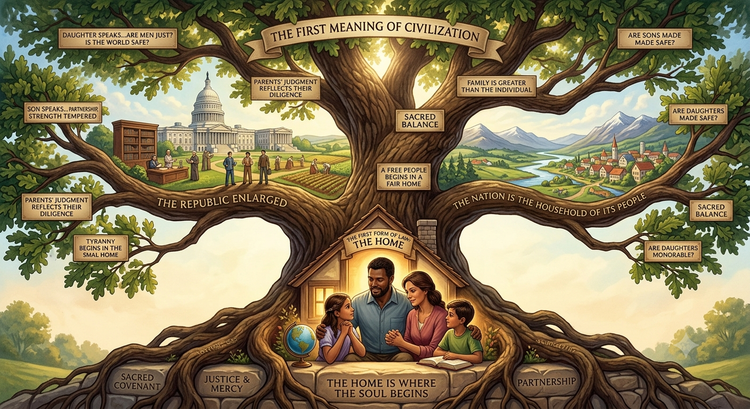
There is a man with a wife and daughter. His daughter comes to him and says, “Father, my tummy is grumbling.”
What does the American do?
He finds a frontier.
He hunts.
He builds.
He invents.
He labors.
He risks.
If a bear comes from the woods, he raises the rifle. The danger becomes provision. The wilderness becomes nourishment. That is the frontier spirit: the determination to stand before the wild, the dangerous, and the unknown and declare that suffering will not have the final word over one’s family.
There is nothing more formidable than a Christian man who believes he must provide for his family and grow the Garden against all odds.
But notice this carefully.
The frontier is not innocent merely because we call it progress.
There were already people upon the land. There were already families, nations, laws, gardens, languages, and sacred places. The frontier spirit became noble when it confronted suffering, but it became wicked whenever it treated another human being as part of the wilderness to be removed.
The Garden cannot be expanded by burning the garden of one’s neighbor.
The Christian frontier must therefore be governed by Christian conscience. Dominion without love becomes conquest. Independence without responsibility becomes abandonment. Industry without morality becomes exploitation. Progress without mercy merely teaches suffering to operate a machine.
America has committed these contradictions.
Slavery.
Dispossession.
Broken treaties.
Segregation.
The denial of dignity beneath declarations of equality.
These are not small exceptions to the American story. They are the places where America betrayed its own confession.
Yet the existence of hypocrisy does not prove that the ideal is meaningless. Hypocrisy proves that the ideal possesses enough authority for evil to imitate it. A nation is not measured only by what it has done. It is also measured by the moral law through which it can recognize what it has done and repent.
This is where Christianity moves again within the American conscience.
Christianity gives America no permission to declare itself righteous. It gives America a measure by which its unrighteousness may be exposed.
The Cross does not become American because a flag is placed beside it.
America must become answerable to the Cross.
This Christian inheritance appears most clearly in our understanding of conscience, law, and the human person.
American law did not emerge from Christianity alone. It also inherited English common law, classical republican thought, Enlightenment philosophy, and legal principles carried across many civilizations. Yet Christianity profoundly shaped the moral language through which Americans came to understand guilt, mercy, testimony, repentance, judgment, forgiveness, and the sacred worth of the individual.
The law asks: What has this person done?
Conscience asks: What am I becoming?
Scripture forms the conscience, but law measures public consequence. Law cannot save the soul, and Scripture is not a criminal code. Yet both speak of judgment, testimony, responsibility, and the difference between accusation and truth.
This distinction is essential.
American justice declares that a person is presumed innocent until proven guilty. Christianity did not create this principle by itself; its history reaches through biblical tradition, Roman law, English common law, and American jurisprudence. But the principle harmonizes powerfully with the Christian warning against false witness and unjust condemnation. The Supreme Court has described its lineage as extending from Deuteronomy through Roman, English, and American law.
The accuser says: He is guilty because I have accused him.
Justice answers: Accusation is not proof.
The state says: We have the power to punish.
Conscience answers: Then you possess the greater responsibility to measure rightly.
Christianity teaches that the accused remains a soul. He does not become an object merely because the state has named him. He does not become less human because a crowd demands condemnation.
The accuser condemns.
Christ intercedes.
That moral structure matters.
It does not mean that wrongdoing has no consequence. Mercy is not the denial of justice. Forgiveness does not turn a lie into truth or restore innocence where guilt has been proven.
It means that punishment must not become hatred.
Law is the public measure of consequence, but conscience stands above the law and asks whether the measure itself is just. If the architect’s measure is false, the house will fall. If the judgment of a nation is false, the nation will fall with it.
This is why America is not merely a nation in which Christians happen to live.
America is a nation whose imagination has been profoundly shaped by Christian ideas: the dignity of the person, the responsibility of freedom, the judgment of conscience, the obligation to serve, the possibility of repentance, and the conviction that suffering must never be accepted as mankind’s final inheritance.
America is Christian not when it boasts of Christianity, but when it performs its duty.
When it feeds the hungry.
When it welcomes the stranger.
When it protects the innocent.
When it restrains the powerful.
When it allows the accused to stand as a human being before the law.
When it carries knowledge into darkness without using that knowledge to enslave.
When it remembers that liberty was given not merely so that the individual may expand himself, but so that he may enlarge the conditions of life for others.
Hate must be taught because hatred requires us to forget.
To forget the neighbor.
To forget the stranger.
To forget the child.
To forget the Garden.
But love is a reminder.
It reminds us that the purpose of the frontier is not to make the American greater while making humanity smaller. The purpose of the frontier is to push back the boundary behind which suffering has hidden.
The Christian remembers Eden.
The American confronts the frontier.
And the New American must understand that the frontier is not the place where another human being disappears.
It is the place where suffering does.



Member discussion