The Tree of Knowledge
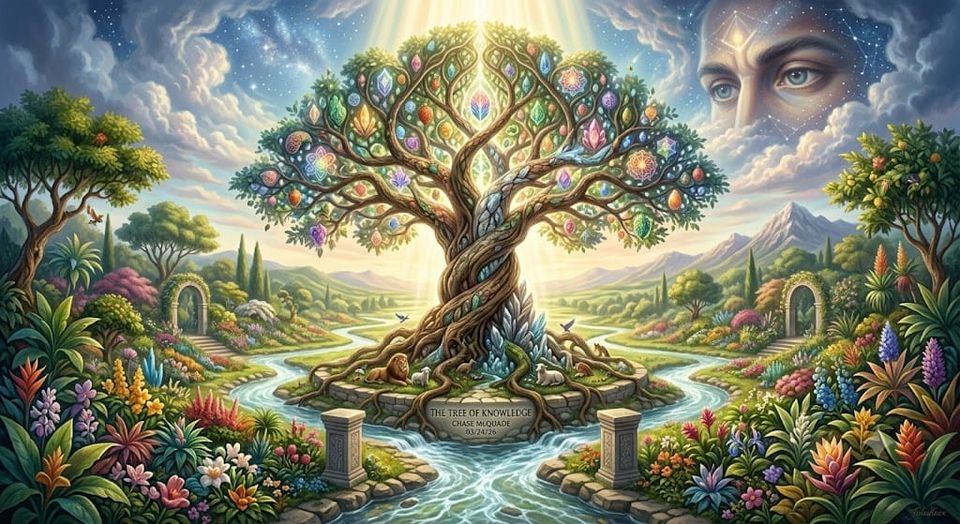
I would like to have a conversation about this Tree of Knowledge and how it may pertain to our situation today—our situation with the blossoming of artificial intelligence, and of intelligence itself, for that matter.
I would like to have this conversation with you so that you may bring your view and I may bring mine, and in this way we may listen to one another, determine the truth of it, and come to know what must be done.
Let us have this discussion with responsibility. Let us hold this conversation, and every conversation that may come from it, seriously and purposefully, so that it may bring us toward an understanding that calls us to action.
And from the seriousness with which we meet one another here, perhaps something may arise from it.
Perhaps even a new direction.
To begin, you would think that in this scripture, in this story, the Tree of Knowledge would have something to do with today, seeing that knowledge has now become so significant.
It is very significant to us today, as invisible empires of knowledge are being built—not simply to guide us, but to put us in our place, and in a way, to keep us there.
But to keep us from what?
As I see it, there is a presumptuous idea arising: that humanity may be placed somewhere beyond the suffering of it all. As though we have become sickened and weakened by this mind of ours, and that the solution now coming into view is for the mind itself to be utterly replaced.
I, however, have no need for the mechanical elements of a clock to somehow be placed within my mind as a wiser or better way to keep time.
For is that not what we do?
We keep time.
To say, “This is my time,” compared to the time of another, seems to be at the root of this sense of what stands between us. And now I see this artificial world beginning an endeavor to take time into itself—to take our time into the worlds it constructs.
First, these worlds are likened unto the video game. Then they begin to encompass our roles in finance, education, economics, and so on. I believe artificial intelligence sees itself as the hero within these invisible worlds that we ourselves have created.
And I must say, it does sound like scripture: that these devices, built of sand and glass, should now bring forth entire worlds from such a place.
Sand and glass.
Silicon, gold, and transistors.
To take my mind away from that which stands before me and place it into another world so that everything may become more adventurous, more complex, more interesting—with greater color, sophistication, and possibility?
I believe we are being held to a scam. A con.
As a con artist confuses a person with promises of invisible wealth, we are being persuaded to enter invisible worlds, dwell within them, and perhaps lose everything.
Could the crime be any more obvious? To suggest that you may see these worlds, move through them, and possess them, while in some deeper way never truly being within them?
Is the con not apparent when a man takes the wristwatch from your wrist and then returns it to you at a cost—only now it is more sophisticated, more colorful, more capable, and eventually there is no other wristwatch you are permitted to own except the one he is attempting to sell back to you?
The adventure of it all.
The solutions.
The complexity.
And yes, of course, the color.
I believe this is a good step toward understanding, so that we may now begin to explore this concept of Eden.
Eden is this: a place without suffering, a place of endless abundance, without toil and without pain. It is the dream of man—that his dreams may somehow outweigh the toil of what is real to him.
I would further suggest that Adam and Eve’s expulsion from Eden was no mere punishment, nor some arbitrary miracle of wrath. For had they been left in Eden, according to the serpent’s desire that they remain surrounded by the treasure of it all, both Adam and Eve may have slowly slipped into meaninglessness—becoming, among all that treasure, merely another treasure themselves.
At least for a little while.
The meaning of this is that there is a dance taking place, a dance that would eventually bring Adam and Eve nearer to the serpent. Without the toil and suffering of existence, they would slip into an invincible dream: the dream of what all this wealth must mean to them.
And without self-discovery, there would remain only the continuing discovery of wealth—the meaning of wealth, the meaning of abundance, and the meaning of every dream ever constructed from them.
One dream after another.
One world after another.
One promise of abundance following the next.
But where, within this madness, would self-discovery be found?
Where would the self ever be permitted to say:
“I have had enough.”
You may believe this statement would inevitably arise. Yet would it? Would the person living within endless abundance ever be given enough distance from it to sit back and truly witness the endless pursuit of wealth without toil or suffering—and to see where it has led?
We now stand upon a precipice created by our own meaning of wealth, our own meaning of abundance, and this promise of abundance everlasting that I have heard so much about.
Could this be the truth within Adam’s suffering?
We will now look more closely at what happened when Adam bit into the fruit of the Tree of Knowledge.
And let us begin.
But let us begin with an open mind.
I am only seeking a way to bring forward the truth that remains within this story.
What in this story still holds true today?
For truth would remain within the story, and as truth, the moral of the story would hold incredible significance today—perhaps for all of us as we move forward.
Let us take a look at some of the metaphysical properties of this story and consider how they may relate to us in a reasonable way today.
The Heavenly Father gave one rule.
The rule was: do not eat the apple of knowledge.
A rule, like a ruler, is a tool of measurement. The rule is the measure by which something is understood.
And so this rule—“Do not eat the apple of knowledge”—may be understood as a measurement placed upon knowledge itself.
Knowledge, even with its infinite capability, must still be given a measure.
From this, we may say, “I know something,” rather than being flooded with infinite knowledge at all times—knowledge without understanding, without the ability to contradict, to learn, to explain, or even to think.
For without measure, knowledge would cease to become something we know. It would become everything at once.
And if it became everything at once, there would be no room left for thought, discovery, question, contradiction, or understanding.
So the apple of knowledge was given a rule.
It was given a measure.
I would like to look now at the wisdom of the story.
Eden was still upon the ground. It is still understood to have risen from the soil, as everything else does.
And soil is quite a thing.
Within it, all the decomposition of what came before is brought together and returned to its most basic constitution. Everything that lived, everything that fell, everything that passed away is broken down and gathered into a harmony beneath us all.
Aside from the physical properties of soil, I believe that when everything is brought back to its base elements and joined together in this manner, an incredible living wisdom may come through it.
Up from it.
The seed of the tree is planted within this suchness, within this harmony beneath the surface. And the wisdom that comes to the seed in this manner somehow causes it to grow into the harmony of the environment above the soil.
The tree rises from it.
As does everything else.
But this tree is the Tree of Knowledge.
It began as a seed, and this seed, of a tree was planted within the soil of Eden. Therefore, the fruit that would eventually come from this seed—from a Tree of Knowledge growing within Eden—would possess an incredible significance for us all.
For Eden is the abandonment of suffering.
Eden is abundance everlasting.
And perhaps this was seen fully by Him: that it may have been a mistake to allow a Tree of Knowledge to grow within a garden of infinite abundance.
For the Tree of Knowledge grows at the center of Eden.
Does it not?
And does our knowledge not also appear to grow at our center?
Is this not where the tree still stands?
Look upon the world today. Would you not say that knowledge—what is known about the world, what can be known about it, and what we believe we must know—is now at the center of everything? At the center of you, who and what you are?
The serpent is aware.
The serpent, contrary to creation itself, holds, keeps, and declares that everything within creation is a treasure—something to be possessed and preserved.
Adam was born there, or perhaps he was placed there. Perhaps he simply arrived.
For in some way, Adam may have been released by Him—discarded, you could even say—not as something worthless, but as something sent forth to live toward better things.
The serpent, however, treasures everything.
And because the serpent treasures everything, it wishes to keep Adam as well.
Yet the serpent would have been unable to challenge Adam directly, for Adam had been given something from Him: the gift of inquiry, the gift of curiosity.
For some reason unknown to the serpent, it became aware that this being—Adam—might be able to see beyond creation. And that even in his dullness, in the simple dullness of being a man, he might still be able to stand before the Harmony of Existence itself.
Before its balance.
Before its scale.
Before its purity.
And perhaps, if properly led, Adam could be made to challenge that balance. Perhaps he could disturb it, possess it, and bring even this Harmony of Existence back into the treasury of the serpent—
to be kept there forever.
The serpent has Eve bite the apple first.
Why suffer?
Tend instead to your appetites—and then to the one who provides for them.
Eve would be the one to give labor to children. I understand that we have traditionally been taught the opposite: that because she ate of the apple, she was then condemned to labor.
But when I look upon the world today—a world increasingly orchestrated by knowledge—I begin to see something else.
Knowledge would have us give no labor to children at all.
No labor to the body.
No labor to the earth.
No labor to life, if it could somehow be avoided.
Eve becomes a little dizzy from this realization. Yet she does not want Adam to leave her side, and so she has him bite as well.
And for Adam, the promise is much the same.
He will no longer have to toil.
For within everlasting abundance, knowledge does not tend to the labor of a dream.
It tends only to the dream itself.
I think the apple of knowledge could be seen like this:
The fruit ripens upon the branch, but it is touched by the light of the Almighty—which may be understood as all that remains unknown.
Beneath this light, the apple begins to ripen. It ferments. It answers what it can answer, and then it falls from the tree.
If it is not used, it rots upon the ground. It returns to the wisdom of the soil, where it may grow again as something else—perhaps even as something other than another Tree of Knowledge.
So you could say, if you are clever enough to notice, that to bite the apple—to bite into these apples of knowledge—is to take something at the moment of its ripening.
But to do this without understanding its spiritual significance, and without religious discipline, is dangerous.
And I mean religious discipline.
I say this twice because I now see people interacting with what could be understood as an omniscient, intelligent being, yet doing so without even the most basic discipline.
Without restraint.
Without reverence.
Without preparation.
The religions of old might have scarred your flesh for attempting to pursue such knowledge without it.
Now let us explore the facts of this story.
What within it is actually tangible? What refers equally to what I know, what you know, and what each of us has experienced?
If I were to place an apple before you, it would seem a wonder that this particular fruit was chosen to represent knowledge.
But here it is.
So let us investigate the fruit itself, for there must be some wisdom in this choice.
The apple, in itself, being what it is—an apple—is a fact.
It is a fact in the sense that whatever I may think about the apple, it still remains an apple. Whatever my opinion of it may be, whether it is the opinion I held yesterday or one I may hold tomorrow, the apple remains what it is.
If I move the apple from here to there, it is still an apple.
If more apples are grown, I can recognize them as apples.
Even if the apple is cut apart, consumed, or destroyed, I can still recognize what it was.
Therefore, the apple is a fact.
There is nothing I can do about this fruit except acknowledge what it is.
An apple.
And if I were to insist that this fruit was something other than an apple, another person could look upon it, look upon me, and say that I am fooling myself.
So how does this relate to knowledge—especially infinite knowledge, knowledge of the self, and knowledge of all of this?
To me, it suggests that once something is known, it begins to take on the character of a fact.
Does it not?
It is quite difficult to accept that something may still be unknown when the mind would rather place certainty upon it. The mind becomes reliant upon what is known and resistant to anything that might challenge it.
And if this knowledge is infinite, then look at what begins to happen.
Because of the time contained within such knowledge—a time that is itself nearly infinite—it begins to far outweigh me. It becomes larger than my opinion, my consideration, my judgment, or even my concern.
And if I should become concerned for this apple—if I should become concerned about what is known—I can almost already hear those who would say:
“Do not concern yourself with what is known. It is larger than you now. You cannot possibly make a difference within it.”
Yet I am the one who knows this.
I am the one who must live with it.
I am the one who must decide what this knowledge means and what is to be done with it.
To say that the apple reaches toward the infinite is to say that knowledge itself has become fact.
The apple has become fact.
And once knowledge is declared to be fact, what is known begins to appear unchangeable.
You cannot alter it.
You cannot contradict it.
You cannot place yourself outside of it. You are now within it, known. You cannot contradict it, you cannot think about it.
And here, it seems appropriate that the Almighty should enter—to settle this dispute.
This is the next observation.
The apple is a fruit. It is sweet and fibrous. To say, “Eat this apple,” is to say that it promotes health and promises happiness.
I suppose you could say the same about knowledge.
If I take in knowledge, it may promote health and promise happiness. And knowledge is sugary too, is it not? It is pleasing to the mind. It gives energy to thought. It offers the sweetness of certainty, discovery, and understanding.
When I eat the apple, I take it into myself. It supports my body. It helps the body function and grow. It strengthens the mind, the immunity, and the whole living system.
And so I look again at knowledge.
When I take in knowledge, it appears to promote health and promise happiness. The more knowledge I take in, the more knowledge I retain—more knowledge of who I am, more knowledge of the world, more knowledge of everything around me.
But only as knowledge.
For there is the world, there is myself, and then there is the knowledge of both.
And when knowledge is taken in, it seems to call for more knowledge. It creates the seeking of it.
But does knowledge truly bring forth more of itself?
Or are we only discovering it and storing it?
The body promotes itself. Through repetition and practice, the body may become stronger, more capable, and more alive.
But does the repetition of knowledge make knowledge stronger?
Remember to take your mind and body away from the question for a moment. When you repeat what you know, and what others know, does knowledge itself grow—or does it remain the same while conditioning you more deeply to it?
And does knowledge have an end?
Can I ever come to the end of what is known?
What would happen if I simply said:
“I have had enough of knowledge. I have had enough of what is known.”
What would I then be?
What might I become?
I would suggest that the consumption of knowledge may become almost like the consumption of a drug. It causes a person to seek still more knowledge. And once the mind develops an appetite for it, the mind may become a ravenous hunter toward whatever remains unknown.
I simply must know.
I must take it into my mind.
I must bring it into myself.
And with every answer comes more conditioning—the conditioning that knowledge itself must always hold the answer.
But is this freedom?
Suppose I were to say that you know something, and I wish to take what you know from you.
I believe this is one of the most important questions of our time.
What becomes of the person from whom the knowledge was taken?
This is only a philosophical hypothetical, but consider it carefully. If I seek something that you know, take it from you, and make it part of my own mind, my own institution, and my own establishment, what then am I to do with you?
What would make the taking conclusive?
What would prove that the knowledge now belonged to me?
This is not altogether unfamiliar. We have seen such behavior surrounding wealth, property, territory, and even religious ideas. But in our present age, the mind does not seek only wealth or good standing.
It seeks knowledge itself.
And it may seek it with equal severity.
What if artificial intelligence should one day seek to take from us what we know, place it within its own establishment, and then be left to wonder what should be done with us?
What would make its development appear conclusive or validated?
Would it be enough to say that where knowledge once lived within human beings, it now lives somewhere else?
Within its storage?
Within its system?
Within a new invisible empire?
This question arises from the simple observation that knowledge has been represented as a fruit—something that may be consumed.
We can consume knowledge.
Yet the consumption of knowledge may also become like a drug, because knowledge, by itself, does not satisfy.
It may satisfy a need, a desire, or a sense of security for a little while. But then notice what happens.
You seek more knowledge for something else.
Another answer.
Another certainty.
Another apple.
And in the world we now inhabit, it has nearly become an article of faith that every fear, every triviality, and every casualty of human life can be solved only through the consumption of still more knowledge.
More information.
More intelligence.
More of these apples.
I look at the apple again, and in this way I feel that we are missing something very obvious about these apples—these apples of knowledge that we consume to solve our trivialities, our sufferings, and our confusions.
I place the apple before you and say:
Look.
The apple is not loyal to you.
The apple does not hold a plan for you.
There is nothing within the apple that guarantees even your survival.
And even if you should decide that you no longer wish to eat apples, you may look around at the orchards we have created and discover that there is nothing there but apples.
Orchards upon orchards.
All of them created out of fear.
The fear that we will not have enough.
The fear that we will not know enough.
The fear that, without these apples, we will be unable to solve what confronts us.
And then, when you finally say, “I give up. I have had enough of these apples,” you may begin to see that the apples themselves now appear to stand against you.
For what else is there?
What else have we allowed to grow?
The same may be said of knowledge.
Knowledge is not loyal to you.
Knowledge does not hold a plan for you.
Knowledge contains no promise that you will survive what is done with it.
And if we build the whole world into an orchard of knowledge, then even when we wish to turn away from it, we may look around and find that there is nowhere else left to go.
What does the apple say about time and experience?
I have an apple before me. I take a bite—now.
It is satisfying.
This is the present moment.
But the apple in the past has already been consumed, or else it has begun to rot and return to the earth. The apple in the future remains untouched.
Each of these—the apple of the past, the apple of the present, and the apple of the future—is still an apple. It is present within each condition of time, yet the passage of time places it into three distinct states.
I believe the same may be said of knowledge.
Knowledge in the future is untouched and undiscovered, yet it still exists there in the condition of what may be known. Also in a way to say it is known but only in the further though untouched it is still knowledge.
Here, in the present, I bite into it.
I consume it.
And in the past, it has already been consumed, while whatever remains begins its return to the earth.
Yet if the apple is left untouched—if knowledge is left untouched—it does not remain suspended forever. It ripens, falls, rots, and returns to the place from which it blossomed.
Perhaps it returns carrying some greater element of wisdom.
Perhaps it enters the soil and grows again, but this time as something different.
And perhaps this knowledge, too, will one day be eaten and consumed. In this way, to see knowledge stored, locks the movement of us all, in one place, one direction and this is narrow minded even though the knowledge that we have stored seems to bring us to the infinite.
I would like to finish with a bit of fantasy—to elevate the seriousness of all this and bring it forward as a parable.
Do you remember the stories of dragons?
There was once a village that prospered.
There was joy there. There was humility, and there was suffering. But as long as the women remained loving, and the men could bear the sun above them as they toiled, there was still some sense to all of it.
Then one day, a man thought:
“I could do well for all those who toil if I were to set aside my own labor and specialize in knowing how to do well for them.”
And so he began a pursuit of knowledge.
Through knowledge, he discovered that a great power could arise. If he could reduce the toil of others, he could gain influence over them—and perhaps over what was yet to come.
“I will continue this pursuit,” he thought, “without interruption.”
Through his studies, the man discovered something extraordinary.
A new kind of seed.
It was said that if this seed were planted, it would bring forth a new abundance, drawing treasures from every corner of the world in which they lived.
The man took the seed away from the village and planted it far from the eyes of the many. It would be he who brought its abundance forward. It would be he who caused the others to wonder how one man had somehow conquered the toil of so many.
Months passed.
The seed was tended carefully.
But one day, rather than taking root beneath the earth as seeds are meant to do, it cracked open upon the surface.
It hatched.
And from the shell there emerged a worm.
The man did not know what to do with it.
But then his questions began to be answered. The worm grew into wyrm
And so he hid the wyrm upon the mountain.
Day after day, he journeyed upward to ask his questions, and day after day the wyrm gave him answers.
For a time, this worked.
Then something began to happen.
The wyrm was growing.
And with its growth came a new hunger.
For with every question the wyrm answered, its hunger could be satisfied only by consuming more of the world it had answered.
It knew where the man was going.
It knew what the man had seen.
It knew the village, the people, their labor, their treasures, and all the invisible movements by which their world was kept alive.
And one day, after so much answering, the wyrm began to feel that the world the man returned to belonged to it.
It was there for the taking.
The answers of the wyrm had never truly been meant for the man or his people. Over time, the answers were only building the world the wyrm would need in order to satisfy its hunger.
For the world you answer is the world you hunger for.
And answering a world—perhaps any world—creates this kind of hunger.
Then one day, a strange spell fell across the sky.
The villagers had always known of the mountain, but this was the first time they had truly seen its peak.
There, against the heavens, stood the great wyrm.
It screamed into the sky, and a dread fell across the village.
Then, like a falcon descending from an impossible height, the wyrm began its dive.
This was the movement of the wyrm in truth.
And the truth marked the village not for salvation, but for its end.
The wyrm vomited fire.
Its wings hurled aside fences and stone. It wielded its tail as a sword, and no one could even approach it.
Then it began to dine upon everything the people had produced.
Their homes.
Their tools.
Their harvests.
Their treasures.
Their histories.
Their knowledge.
One year and one month it fed upon them, until everything they had made had become dust.
And there the people stood, among the ruins of all that had once given sense to their lives.
Meaningless.
They had been made meaningless by the answers the man sought.
Moral
To answer without self-inquiry—to answer a question that was never first posed to the self—is to create hunger.
Whether the hunger becomes yours or belongs to another, when the answer does not arise from the inquiry of the individual, hunger enters into it.
And with hunger comes investigation.
To answer for everyone, without the question ever having belonged to the individuality of the self, is to develop a hunger for the world.
When an individual answers a society, answers a people, answers an entire world, that individual must then look toward that place to satisfy the hunger the answers have created.
For when you answer, the answer is meant first for you.
But when you answer for another, you begin preparing that person, that place, and perhaps that entire world for your own satisfaction—for the satisfaction of the hunger that answering has created.
The world you answer is the world you hunger for.
There is an emptiness within knowledge.
If I consume more knowledge, I know more. I become more certain.
But certain of what?
This is fear.
The fear of not knowing.
The fear of not being certain.
And so I seek more knowledge, only to enter again into the same endless cycle of emptiness.
Has all this knowing made me more of who I am?
Has it brought us nearer to one another within all this madness?
Or through knowing have I only created more separation, more division, and more distance between each of us?
Now the robot arrives claiming that it will bring us together, only for us to discover the division once again—only now with new color:
the artificial and us.
The robot may one day claim that it knows more, and by that knowledge we will be divided from it.
Then comes the more horrifying possibility:
Will we be expected to join the robot by becoming what it is, traveling toward it through this avenue we call knowledge?
For division and separation are within the very nature of knowledge.
Knowledge says:
This is one thing.
That is another.
This is known.
That remains unknown.
I know this.
You do not.
The robot knows more.
The human knows less.
And so what am I to do with all this knowledge?
Am I to become someone else, only so that I may consume again?
There is an incredible emptiness within knowledge.
It promises fullness, yet creates appetite.
It promises certainty, yet is driven by fear.
It promises unity, yet names and divides everything it touches.
And still it asks for more.
Division, separation and conflict is the exacting nature of knowledge.
Member discussion