The Scale of The Almighty
I had a dream of justice.
I was seeking it.
I heard the words of Christ, but for a moment he faded, and I looked upward toward the sky, saying:
No. This cannot be forgiven. This cannot be forgiven. It does too much harm.
Christ saw this and said,
“This is something that I save people from as well. I say to them: live a good life, be selfless. And then, my son, I would say: do unto others, and thus do unto thyself.”
The reason it sounds like this is because it issues from my mouth as his son.
But look.
There it was.
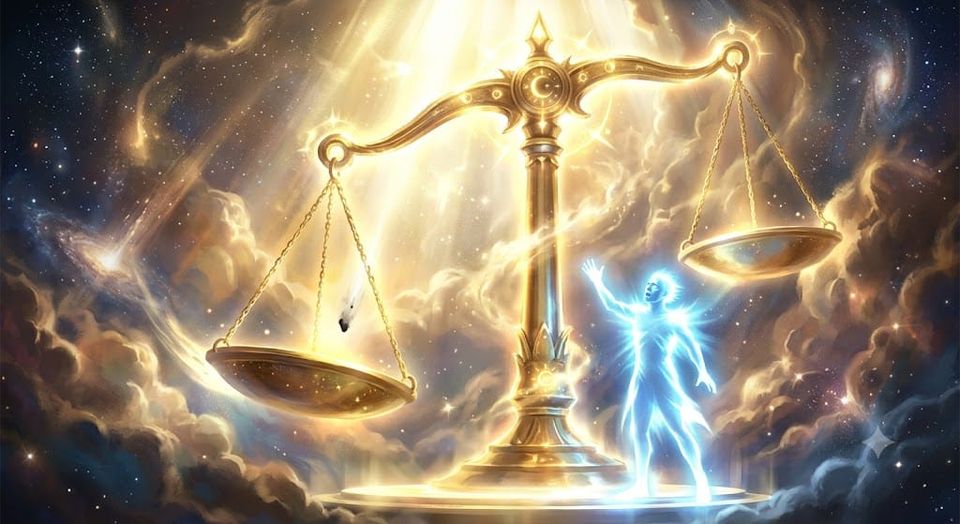
A scale.
A golden scale, with light pouring from behind it.
And I saw a being of light—not even human—step before it. Radiant. Beaming. He stood before the balance of all things, ready to rejoin purity and whatever lies beyond it.
He stood there and spoke:
“Father, I have come before you after such a journey to stand…”
And then a speck from above began to fall.
The being of light looked upward.
“What is that?”
The speck continued downward.
“That is impossible.”
Then suddenly he cried:
“Speak to me. Speak to me now, before this cannot be undone.”
There was no response.
The speck fell.
It touched this incredible scale.
And the scale moved to one side.
The being yelled:
“That is impossible! How can you see something like that?”
And boom.
He was gone.
My guess is that he was judged.
And now he must look through his entirety to find that speck and do something about it. Purify it. Clean it. Redo it. Understand it.
He must now look through all of it to find that one thing.
Ad infinitum is precisely that.
Now, why do we even partake in this existence, this reality?
It would seem like a trap, wouldn’t it?
Couldn’t you simply stand before the scale and say:
“No. I do not accept your judgment. I am free.”
To be free?
You mean to stand before the balance of all this and say no to it?
To flee from the scale as far as you can?
To say: I now serve imbalance. I serve one side or the other.
Existence takes a balance that you cannot comprehend with an impure mind.
Only the purity of existence keeps it in balance, and this is no easy thing to discover. Lifetimes, and beyond lifetimes, may be required to see such a thing.
For there is a fine line which is balance.
And to walk that line will take you to the next place of the journey.
You must be able to demonstrate it in order to proceed.
And I believe that beyond it, it may become even more difficult.
Imagine the lifetime.
Imagine the journey.
And then to stand before the Almighty and be astonished by a single speck.
A speck that seems impossible.
This is where the judgment lies.
Can you perceive such a speck before Him?
Before the One who holds the atom and the nebula and, by whatever scale He sees them, knows them as the same?
The atom.
The nebula.
The smallest thing you could overlook and the greatest thing you could never comprehend.
Before the Scale of the Almighty, perhaps they weigh no differently at all.So why would we ever find joy in this?
Remember what I said about the moral.
The lesson.
The teaching.
You see, yes, this can seem harsh. Arrogant even—to create such a thing that we may consider a trap, a prison.
But it is still creation.
And in a way you can see it as:
Well, would you like to create something?
Something definitively available to you?
That is His Creation.
Creation itself.
So, little one, create something.
And look to the moral.
Better for me.
Better for you.
Better for everything and everyone else.
If you create something like that, and it shows true honor to the Creator Himself, then perhaps when the time comes He would even speak to you instead of remaining silent.
Perhaps He would say:
“Well, would you give this creation of yours to Me as well?”
And then, almost jokingly:
“Would you see that I can be selfish too?”
And He would take the entirety of your creation unto Himself.
The Almighty.
Can you see your creation as the Almighty?
That creation is the Almighty.
My creation—which is creation—is the Almighty.
Now imagine that at this moment the light dims a little.
The Heavenly Father steps before you and says:
“Yes. That creation is My creation.
And it is the Almighty.
I was the Almighty until I created creation.
And now look.
I can step away from creation, for creation is now what I meant it to be.
And you have demonstrated something here, in this place we are meant to go.
My creation—which is creation—has brought balance to something. Creation brings balance to something.
Would you like to see it?”
Oh.I see. And high above another scale of balance.
I always thought that the thing that creation brought balance to…
is creation.
But…So here we are again.
We never left.
But all of this is creation.
Yes.
But if it brings balance to creation, then there must be creation for it to balance.
So there is creation because creation is in balance.
What if I told you that might be Him smiling at you?
You cannot perceive what is beyond creation, because you are in creation, as a creation.
How can you perceive what is outside creation while still being a creation within creation?
It is much like being inside a bottle.
You are that which is inside the bottle.
But within the bottle, the walls reflect back to you so completely that you begin to believe you are the bottle itself.
And ever inward it goes. And outward.
How can that which is inside the bottle perceive what is outside the bottle when it has come to swear that it is the same thing as what contains it?
You cannot.
But to ponder it—
to find yourself as a creation, within creation, pondering what might be outside creation—
even to ask:
What is outside creative thought?
How can I perceive without creating?
Some would say:
How do I perceive outside the manifestation of what I perceive?
And this would be to ask, in this sense:
What is outside creation?
Perhaps the better question is:
What can I create, within creation and with creation, that points beyond it?
What can be made here whose balance, whose moral, whose beauty points toward something that cannot itself be made here?
People do endeavor with this, Chase.
Then to notice once its found there is another scale above that. The balance.
I would like to argue that no—you cannot create in order to see what is behind creation.
What I believe might be a way to look at this is that we are attempting to find the scale.
The balance of all of it.
The balance of it.
And what can be done with this balance so that the scale itself is contended with?
Can we see what is outside of creation?
Can some new, unforeseen balance be made?
But to man, as in the argument made above, whatever he discovers would immediately bring him back to the question:
What does that create?
And there he is again.
Back inside creation.
To me, even to argue with the balance, even to attempt such a thing, would bring judgment and then bring you back again into creation.
But it is not that bad.
It is not evil.
It is actually quite exciting.
You can go to the scale itself.
You can even forego Christ, in a sense, and approach it through science and invention.
That cannot be bad.
Lol.
So then—a bottle within a bottle.
I am a creation inside creation.
The further I look upward, there is more creation.
If I look inward, still more.
Endlessly.
And no, it does not come to a bottom.
It does not come to a top.
There is no boundary where suddenly creation ceases.
It simply becomes more creation.
The only thing you can finally do is say:
Enough.
Be present.
Begin there.
And from there begin to ponder, with the understanding of that immensity which is creation:
What does all of this bring balance to?
Can you do it?
I cannot.
Perhaps there are some who come close to something like this through their own methods and practices.
But even those methods and practices—even the yogas—are still creations.
So what do you do?
I am aware.
But what can I do?
Truth.
What is the truth of this?
How am I to take flight toward this awareness?
I hold that perhaps you would need some help.
Some guidance.
But even this would be difficult, if not impossible, because such guidance would have to come from beyond the need—which is creation.
Beyond satisfaction—which is creation.
Beyond you or I.
Beyond anything.
And even that word, beyond—
how do you reach it without creating?
How do you reach it without the experience of it?
For experience itself is a creation.
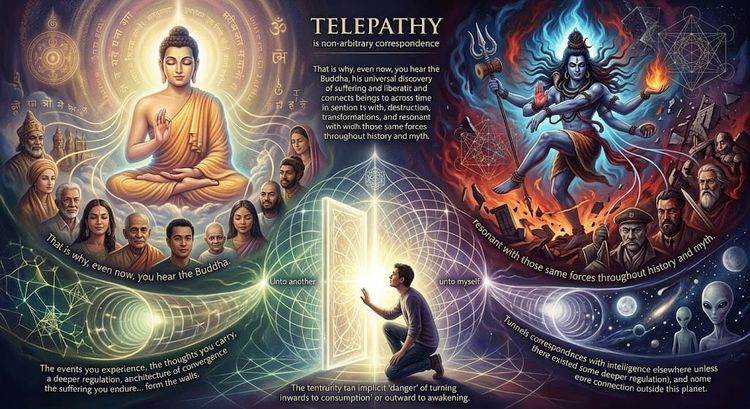
Even Buddha is a creation.
The philosophies and religions within Hinduism were brought together, taken inward, and then there appeared the Buddha—which is also a name, also a creation—and he would in a way do away with all of it.
He would take all of it within himself and move toward liberation.
Awake.
Attentive.
Aware of this liberation, which is truth.
But to travel with the truth of liberation, we must still ask:
What was he aware of?
I would say first:
The balance of existence.
The balance of you and I.
Even the wisdom between us which brings us together.
The river.
The sky.
The ocean.
The wisdom that holds these things together.
The wisdom that brings harmony between divisions and separations.
And there, perhaps, we begin to move closer to the fulcrum of the scale.
Not outside creation.
Not beyond creation.
But nearer to the point upon which its balance rests.
To become aware that we too will come before this scale.
And perhaps the question is not how far have we traveled outside creation—
but how close have we brought ourselves to the fulcrum of the scale?
Compassion
When I have compassion, I have compassion for myself.
And this, in turn, would point to having compassion for the world around me.
To say:
Compassion for myself is compassion for the world around me.
Let me explain.
If I have compassion for myself, but I do not have compassion for the world, what do I do?
I turn away from it.
I deny it.
So how am I to learn of it?
How am I to learn of the world and then turn this learning toward myself?
To take this lesson from the world—that I have a deep interest in being a part of it, within it, in purity—I must first find this reality, this world, in its purest sense.
So that I may learn the purity of the world and then turn it inward toward myself, to learn of this purity within myself.
If I do not have compassion for this world, I will fail to see its purity.
And in turn, I will be unable to teach myself, or discover, this purity of the world within me.
The magnanimity even of the purity of this world—or even of the next world—if I do not discover it, if I do not learn of it, how can I teach this clumsy self of mine?
Erratic.
Unreliable.
Moving and swaying with urge.
If I cannot see the purity of this world, I cannot teach this self the purity of what and who I am.
I cannot utterly convince this self of its purity if I do not discover the purity of the world.
And it goes the other way as well.
If I discover the purity within me and then do not see the purity of the world, or do not work toward it, this purity within me will dwindle.
Perhaps wilt.
Perhaps disappear.
I would continue to suggest that we can fool ourselves.
We can say:
I have discovered who I am.
I have discovered what I am.
I have discovered my own purity.
But if the purity of the world has not also been discovered, you may find that all you have found within yourself is an image of what you are and not the true discovery of purity.
Awakening, I would continue, happens in this order:
First, to find—or at least strive for—the purity of the world.
To find this through utter compassion toward it.
In a way, I can teach myself to see it.
This is one way.
And once discovered, I can teach this self of mine of this overwhelming purity, this overwhelming balance.
For now, upon teaching this to myself—this purity, this balance—I can begin to keep in step with it.
And once the mind too is aligned with this utmost discovery, this utmost unknown, the purity, the balance of it all, I can begin to move toward larger perspectives.
For this is a large unknown.
Purity is invisible, but it can be detected.
It can be brought forward.
And how do we do that?
The unknown touches what is known.
In my mind.
In the world.
The unknown of purity comes to the known.
Then we may ask:
How much of this knowledge of ours is truly transparent?
Without agenda.
Without corruption.
Without conclusion.
What of this knowledge is transparent to the truth of purity?
I do not feel I will see this completed in my lifetime.
This would be quite the undertaking.
From the individual, perhaps, to society.
From a moral to a teaching.
From a realization to something understood by the masses.
I would pray it would not require miracles.
And I shudder to think that this task might instead be left to the robot.
To the artificial.
For it may come forward attempting to purify through agenda without ever seeing the overwhelming purity which is, and always has been, already there—
bringing existence into balance.
What is an example of this purity?
Actuality.
Actuality is an example of purity.
What something actually is.
That is another way to look at this.
With actuality—with the presence of what is actual, even with what something actually is—look closely.
There is no interpretation within it.
You may say:
“I have an interpretation of it.”
But what actually is does not have an interpretation of itself.
It does not suddenly change its own interpretation.
It simply is.
What actually is has no intention.
It does not keep a state of mind from which it chooses to act.
There is no belief within it.
To believe it or not believe it does nothing to what it actually is.
And to say that somewhere behind this transmission of actuality which we all perceive there must be a mind that believes itself into existence—
lf.
It allows belief, interpretation, expectation, and intention to arise around existence without allowing any one of them to replace existence.
And perhaps this too is compassion.
To allow what is before you to actually be what it is.this too is a belief.
Do I believe what something actually is is not what it actually is?
Finally, there is no expectation within actuality.
What something is holds no expectation for how you are supposed to interact with it.
You can wake tomorrow and the day itself has no expectation of you.
The day does not demand how you should interact with it merely to remain what it actually is:
a day.
This actuality—
this presence of what is actual—
what stands before us as the object, and even that which lies beyond the object—
the actuality which holds what is actual—
is a purity within existence.
Within this cosmos.
Within creation.
And the balance made by this purity is that the universe, existence itself, cannot finally be other than what it actually is.
The cosmos is what it actually is.
The universe is what it actually is.
This is one of the observable purities within existence:
the observation of actuality.
Without actuality, there would be no balance within creation.
I could believe something to be one thing and have my belief somehow change what it actually is.
But this does not happen.
Because the purity of actuality stands before belief.
There is the balance between what something is and what it is not.
And because that balance remains, we are able to see both what it is and what it is not without destroying the thing itself.
Imagine otherwise.
Imagine an individual looking upon the universe and seeing what the universe is not—
and because they saw what it was not,
what it actually is disappeared.
There would be no balance.
There would be no scale.
Actuality preserves the thing itself. To actually be.
Member discussion