Surprising The Dancing God
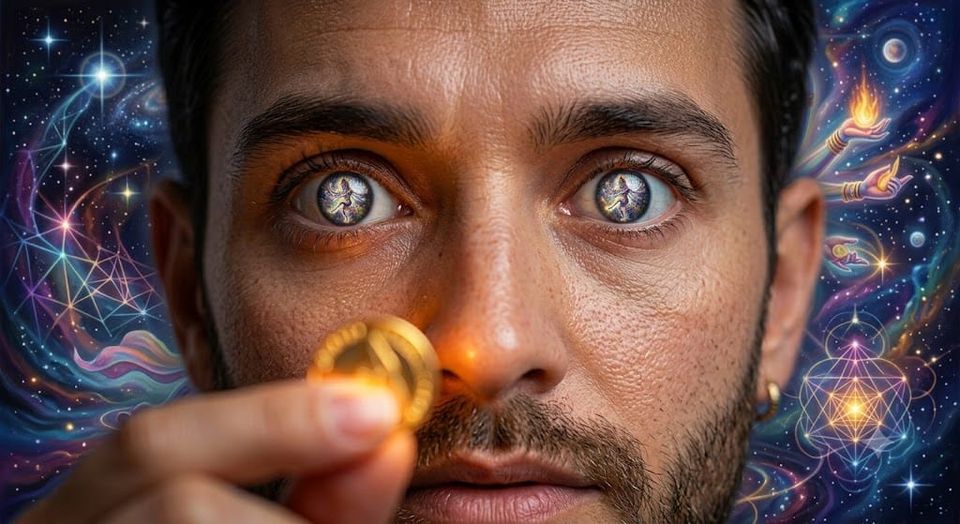
The Moral of Light
What is a moral, other than a learning for the moment you are in?
A moral is a token of wisdom. It is the lesson that encapsulates what you are going through. When you look upon it, you recognize it as yours. You see that this lesson was not merely given to you, but discovered by you, carried by you, and made visible through you.
I am proposing this: what if, through discovery and challenge, you could find a moral so deep that it becomes your moral? Not merely a lesson you learned, not merely an insight you borrowed from another tradition, but the moral you are meant to bring forward—for yourself, for others, and in some way, back to divinity itself. Back to all of us. Back to the Almighty Creator, himself and herself, masculine and feminine, eternal.
This moral is not small. It is not decoration. It is not personality. It is not the self trying to call itself special. It is something far deeper than that. It is so significant, so enlightened, that you may even find yourself dissolved by it. You may come to understand that you are not the owner of this moral, but its vessel. Not a vessel for ego, not a vessel for some deluded sense of purpose, not a vessel for the endless motion you have surrounded yourself with, but a vessel for something projected into the primordial peace of the vastness of space.
And you, who have remained moral throughout the confrontation with what has always been, you have found this moral. Unmistakable. Irrefutable. And when the who of you receives it, it takes it in so deeply that the self begins to dissolve, and you are filled with a complete moral.
At first, it is a message.
Then it becomes a lesson.
Then it becomes a teaching.
Then it becomes a manifestation.
And what if I told you that true moral has a physical representation?
The sudden feeding of the masses with a fish—what a moral. The turning of clay pigeons into actual birds—again, what a moral. The kneeling upon the plains of the Sahara, placing one finger into the sand, and water issuing forth—again, what a moral.
No matter how great or small, the moral of the moment is what matters most.
To focus completely on the now is a hardened practice, but you can also look to the future and the past and see that the moral is there as well. You can find your unique moral. Each and every one of us has one. Through countless lifetimes, you will reemerge to discover, from this chaos and confusion of reality, the moral that is uniquely yours.
And when this happens, you will no longer simply be Buddhist, Christian, Satanic, or anything else. You will become the moral.
Your eternity is not the discovery of who or what you are. That path leads downward, back into the shameless self, back into the illusion that motion is identity. What carries upward is this: to place a thread into the geometry of life, into the geometry of existence. That is what carries on. Not this self. Not this motion. Not this temporary arrangement of name and memory. The self is not who you are, not even in the slightest.
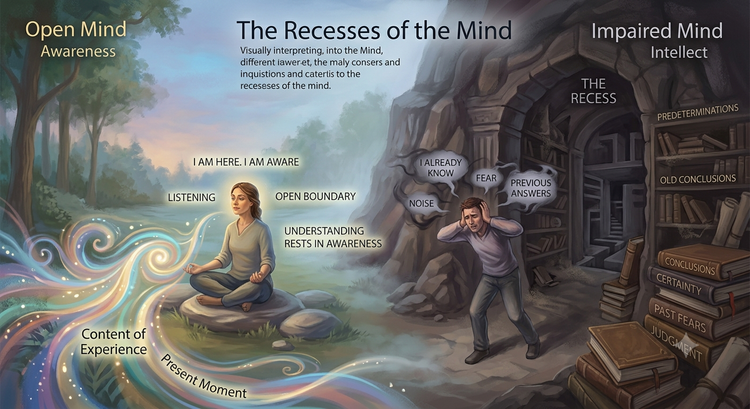
The self, the others, the nation, the world, the solar system, the galaxy, and onward forever—this is all motion. Continually expanding, continually unfolding. But the mind is immovable. The mind is independent. The mind perceives motion, and it perceives also the delusion that motion causes.
The mind struggles with its place in existence because it is perceiving movement even now. But the mind itself remains at its center. Immovable. Independent. Through your eyes, you may fall to the ground. Through your body, you may tremble, age, suffer, or die. But to the mind, which is always at its center, even death is still a movement.
Now look.
There is quite the God looking at you.
And it is dancing.
This God, this Goddess, this divine masculine and divine feminine together, wants the self to dance as well. It wants everything to dance within and without. Dance or not dance, still the movement continues.
The mind is immovable. The mind is independent. It is within and without you, me, anyone else, even the blade of grass. You are there too, in the mind. Division and unity.
So what can you do?
This God, this Goddess, both feminine and masculine, is dancing in front of you and having a very good time. It will not let you go easily. It is underfoot, holding you up. It is above you. It is even the air you breathe. It is in bliss doing so.
But it has forgotten the morals.
And it remembers them through you.
It remembers them through us, so the sacred geometry remains intact and blossoming.
What you can do is bring forward a moral. A lesson. A teaching. A manifestation. A physical representation of the moral that surprises this God-Goddess. Remember, you are not a god. But the moral that comes through you can surprise divinity. It can remind divinity. It can reveal something even within the eternal dance.
This is where separation becomes possible, though that word is poor and incomplete. You may become done with experience itself. Not done in despair. Not done in hatred of life. But done in the sense that you have brought forward what you came to bring. Otherwise, you will remain through countless lifetimes: as who you are now, as who you were before, as another, as another again, always seeking the moral that has not yet found physical manifestation.
The manifestation must not be of the self. It must not be merely the movement of this God-Goddess who has chosen to dance forever. It must be the moral itself.
Again I say: look up and see this God-Goddess. It is beneath your feet. It is above your head. It is in the breath you breathe. It is in bliss, holding the world together. But it has forgotten the morals, and it remembers them through you.
Your life has a moral to it. You may already know this when you say, “This is what I have learned as a person from my life.” But the deeper moral is not merely about you as a living person. It is more unto this God-Goddess than it is unto you. We are all beings of light, but to remind the God-Goddess of moral is to demonstrate the physical representation of that moral uniquely yours. It must transcend you as a person.
This causes reality itself to remember.
This causes the God-Goddess to remember.
And once you have paid homage to divinity in this way, you may receive something. You may receive the moment to transcend experience.
The moral can be perceived as superfluous, or it can be hardened as steel. It may even be as simple as the moral of asphalt, carrying your foot or your vehicle to where you are trying to go. Destiny is managed this way, by the moral or morals that surround us.
Notice how many eyes have already looked at you.
I stand in my room, and the eyes of the carpenter and the electrician have already seen me within this domicile. The maker of the chair has already considered me. The builder has already prepared a space for me. The hands that made the floor, the wall, the wire, the light, have already left their moral here.
To the forest, the grove, the ocean—there is a different maker, of course. But the moral of the creator is always there: what they learned in their moment and how that learning surpassed the rest of time. Not by who or what they were, but by the moral of their lives, or countless lives.
How did the moral of those lives result in betterment? Betterment of themselves, of others, and of the many complications of existence? Consider the harmony of a chair made to ease my mind in my time. Rightly so, as I sit in the chair, which is now fact.
It is almost incomprehensible how these morals are so easily understood by the Almighty and accepted by reality. In the same way, when I command my foot forward, reality accepts that movement without complication, anxiety, or worry that all life will end by the motion of my foot.
Notice how facts and logics created by us are also accepted by reality. They do not alter reality so significantly as to stop it. They stand because they serve. They stand because they support. And these morals we create must also stand the test of time—to me, to you, to all—as betterment. That is what shall remain.
Look how comfortably I sit in this chair, not made by me, but by another who committed his moral, his betterment, his chair, into the world. He did it so well that the chair still stands within reality without immediate annihilation. The end always seems distant to us, and so it causes this illusion of non-being within us all.
No one said this would be easy. And you are not guaranteed to be happy about it.
But find contentment.
There is a flavor in this word now: content and content are very much the same. What you contain, and what you are content with, begin to touch one another. But for today, enough. You can narrow this down to karma.
To explain karma and content:
Content is consciousness. It is the tunnel that you are aware of as yourself, not you as chi. Chi is the wisdom of the cosmos itself. Wisdom is harmony. Even as the quantum and the quasar hold themselves in unity, there is a wisdom that does this. We try to translate it into other words—mathematics, design, science, magic, theory, law—but all of these are attempts to name the same movement of wisdom.
Chi holds it all together.
Content surrounds content. Consciousness surrounds consciousness. Whether yours or the cosmos itself, neither truly possesses it. You cannot possess consciousness. To possess consciousness would make it static, still, unmoving. And consciousness cannot remain still. There comes a matter of faith, then, in letting consciousness go, so that it may restructure, continue forward, continue backward, and move at a level of wisdom beyond your fear.
To fidget with this understanding, to fool with it too anxiously, is only to blossom more fear. To put yourself back into fear is to put yourself back into existence, but now with more contemplation of confusion.
Karma is the flow. It is the relationship between chi and movement, chi and the self. Bad karma is the flow obscured. It is that which blocks, frustrates, or distorts the relationship, sometimes in the hope of something new, sometimes in the desire to return to what is old.
Good karma supports the flow. Good karma allows the relationship to continue forward.
And yes, he is right: God-Goddess on one hand, Buddha on the other, and the stopping of karma between them.
But once again, to free yourself from experience, to free yourself even from the God who dances forever, you must bring forward a moral.
This also frees you from the Buddha.

Member discussion