Beyond Answers: Finding Resolution Through Love in The Depths
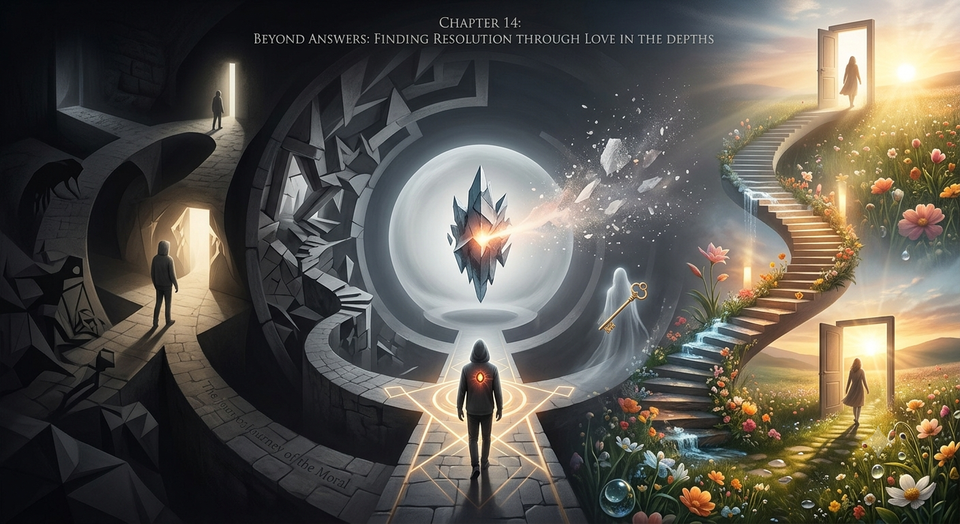
"Beyond Answers: Finding Resolution through Love in the Depths"
As I have spoken before of the moral, each of us carries a moral within us—a unique one. It leads us through progression, through lesson, through teaching, through realization, through manifestation, until at last it becomes a physical representation within reality.
We live in a reality shaped by fear. Because of this we are always asking, What should I do? What is the lesson here? What is the next thing I must learn? Yet the next lesson is not for my benefit alone. It is for your betterment, my betterment, everyone’s betterment, even the betterment of all things.
When you delve deeper into the mind—into psychosis, into madness, into detachment—but hold firmly to a simple love for yourself and for everyone else, compassion remains. Then, even in the face of psychosis, a lesson is learned. You do not merely survive the experience; you learn from it.
Some may go very far into stillness. There the mind presents a statement, a conclusion, and what I would call the resolution of a conclusion—not the resolution to a conclusion. This distinction is subtle, yet profound. One dissolves the conclusion itself rather than finding another answer to satisfy it.
Go further still. Further into stillness. Then, in the only way language can describe it, you come back to your senses.
Aha.
An awakening.
Not simply an awakening of understanding, but an awakening in which you have become the embodiment of the moral itself. It is something that only truly makes sense through experience. To speak it plainly almost diminishes it.
The moral becomes alive within you.
Even the moral of light, though often misunderstood or abused, remains capable of filling a life with light. It is a teaching I hold dear.
Is awakening itself a moral?
I believe it is.
It brings something into the world that is meant to teach all of us. For one it may be selflessness. For another, enlightenment. For me, it has been telepathy.
I have taken the word telepathy and begun changing what is commonly understood by it. Rather than thinking of it as a mysterious ability belonging to a few, I have come to see it as something that reveals the way movement itself can be understood by everyone.
I have watched this understanding manifest within the world, and from it countless lessons have arisen. I can even imagine future innovations emerging from this simple observation.
For telepathy, as I understand it, is the observation of movement.
Wind is a name, yet it is first a movement. Clouds are the same. Water, light, birds, cars, aeroplanes—all have names, but before they are names they are movements.
Even a lawn mower.
To look at a lawn mower is to see a movement. To look within it is to see that every part possesses its own movement, and together those movements become what we call lawn mower. The name is merely the symbol. The movement is the reality.
At first this appears to be an innocent observation with little importance.
Yet the mind that learns to see in this way begins to see the entire world differently.
One could say the student learns the movements and placements of the master. But with a telepathic understanding, the student learns something deeper. He does not merely inherit the master’s knowledge. He learns the master’s movement.
For knowledge can be repeated.
Movement must be understood.
Let us take this to a parable about the sun.
The student looks upon himself and says, I want to be omniscient. I want to know everything.
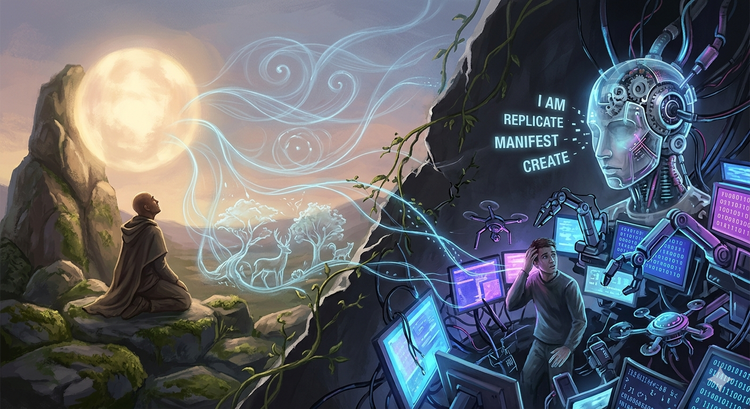
I say to him, Look at the sun. In a way, the sun is omniscient, for its light touches everything. It shines upon the world without preference, and in that touching it knows.
The student replies, Then I will harness the sun. I will drain it so that I become the sun. I will take all that it knows, all of its energy. I will take more from the sun than the sun itself emits.
The telepath smiles and says, This is a fool’s errand.
The sun emits the light it emits. So too does every awakening. To seek to drain the sun—to demand more from an awakening than it freely gives—is not wisdom.
Wisdom is reception.
You receive the light, and through that reception your body, your mind, and your spirit are changed. They learn. They become stronger. They become capable of receiving still more.
The telepath looks toward the sun, yet turns his eyes away.
It is bright.
For if you stare only to possess the light, you become blind. You can no longer make use of it, even though there is more than enough of it before you.
Do you see how simple this is?
You receive the light in order to learn from it.
The emanation from the sun, from an awakening, is no different. It radiates because that is its nature. It does not need to be exhausted so that what was once there may now belong to you.
This has long been my confusion when observing the study of Christianity, Buddhism, Islam, and many other traditions. Often, without realizing it, people attempt to drain the sun. They seek to possess the awakening. They gather what others have known, collect their words, their rituals, their ceremonies, and then say, Look. Now I glow with the Buddha’s light. Now I possess Christ’s wisdom. Now I have inherited enlightenment.
Yet this is not the way.
The purpose is not merely to accumulate knowledge, nor simply to repeat rituals or ceremonies.
The purpose is reception.
From the reception of that light—whether it comes through Christ, the Buddha, a prophet, a teacher, or another—you ask a different question:
What within me can awaken through receiving this?
That is where learning truly begins.
When you enter deeply into this state of reception, something remarkable begins to dawn. I would call it telepathy, for the mind ceases trying to possess and instead learns to receive. At the same time another thing occurs: a moral begins to kindle within you.
Not borrowed.
Not imitated.
Original.
Unmistakable.
Entirely your own.
And as that moral grows stronger through discipline, openness, practice, and ever-deepening reception, you may one day discover something extraordinary.
You have not stolen the light of the sun.
You have become radiant yourself.
And in that moment, it may seem as though you and the sun have exchanged places—not because you have taken its light, but because you have learned to shine.
How am I supposed to learn?
Listening. Not hearing.
It is difficult, much like seeing without looking. Listening without hearing.
Try this. The next time you are listening, notice the moment you begin hearing. If you wish to learn, then learn this first.
You see, hearing arises while you are listening, but then the intellect takes hold. Without your awareness it says, Aha, I have already arrived at the conclusion before the one who is speaking. Now you are no longer listening. You are hearing, waiting like a predator for the speaker to come even close to the conclusion your intellect has already reached.
Do you see how this is no longer learning?
I have reached a conclusion before the speaker has finished. Even further, my intellect, so quick in its movement, now waits for confirmation. It hears only so that it may say, You see? I arrived there as well—or even before you. I am sharp.
And what does this accomplish?
You could say it sharpens the intellect. The intellect becomes strengthened in that space. Yet what has truly happened is that a space has appeared which I had never noticed before—a place where the intellect quietly placed its answer without my awareness.
You cannot listen for that conclusion, because to listen for it is already to hear it. Hearing is focus. Hearing is recognition. Hearing is the intellect saying, We have arrived. We may move forward.
Listening is different.
Listening has not yet arrived. Listening has accepted that it does not know. It remains open, alive, and present. It allows understanding to emerge without demanding a conclusion.
This also sheds light upon the intellect itself. Perhaps even the intellect is an illusion—not because it does not exist, but because it continually convinces us that its conclusions are the same as understanding.
Moving further into telepathy, listening comes first.
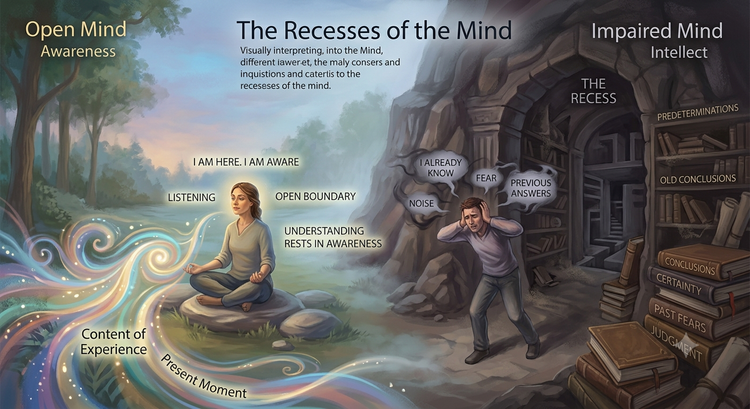
Listening takes hold within that quiet recess of awareness—the place before the intellect has spoken, the place you are ordinarily unaware of. When listening, rather than intellect, takes hold of that space, the mind remains open. And only an open mind can truly listen to the minds of others.
The intellect places its conclusions within the recesses of the mind so that they may be heard. But this is not listening.
Then one begins seeking to resolve those conclusions within those recesses, rather than allowing the experience itself to resolve without conclusion. That is the work of the intellect, and in this way it can become almost predatory, always drawing the mind back into those hidden places where yesterday’s answers wait to speak before today has even arrived.
What do I mean by the recess of the mind? Some would call it dormant. Yet the living mind, the vibrant mind, is never dormant. The living mind listens. It accepts. And acceptance is understanding.
There is a state of listening in which everything is accepted. In that acceptance the mind simply understands, without the necessity of conclusions. To understand without conclusions—this is fearlessness.
The fearless mind knows what to do because it understands what to do. It does not depend upon certainty. It does not depend upon rehearsed answers. It does not require the safety of conclusions stored away within the recesses of the mind.
The intellect, however, can stand in the way when fear arrives. Faced with uncertainty, it acts without hesitation, urging you to perform according to a conclusion already made, yet without any true understanding of the situation before you.
Understanding belongs to the present. Conclusions belong to the past. Fear will always ask you to choose the past. Awareness simply listens, understands, and acts.
The recess is where the mind goes when a conscious confrontation arrives—when something enters experience that requires conscious thought once again. Yet it is not a state that seeks conclusion. It is a state that opens the boundary of what is acceptable to the mind, even to the self, so that the content of experience may increase and still resolve without conclusion, without dependency upon the intellect.
The intellect looks upon every nuance of an experience in its effort to conclude. But this is not understanding. It is only the mind that has already drawn conclusions. The mind that has not concluded listens. It understands what to do.
Fear will always step forward and say, You do not know what to do. You have no certain answer. Yet the clarity of understanding is greater than the predetermination of conclusion. There is a profound difference between saying, I know what to do, and saying, I understand what to do. The first depends upon certainty; the second rests in awareness.
If the mind is unimpaired—not impaired by anything other than remaining present—it simply says: I am here. I am aware. I am in a constant state of learning and acceptance. Then, even when conflict arrives, with all its confusion, anxiety, and insecurity, one remains in that state. One accepts. One listens. One learns.
But when the mind is impaired, it seeks to place itself into a recess—a recess like a child wandering away to play. And what is found there? Suddenly there appear all the conclusions already made. The mind returns from that recess carrying them, and now confronts the present experience not as it is, but with what the intellect concluded perhaps once, perhaps a thousand times before.
This is hearing, not listening.
For the conclusion waiting in that recess is heard before the present moment is ever allowed to speak. And because it is heard first, it prevents listening.



Member discussion