Earth, Bread and Grave
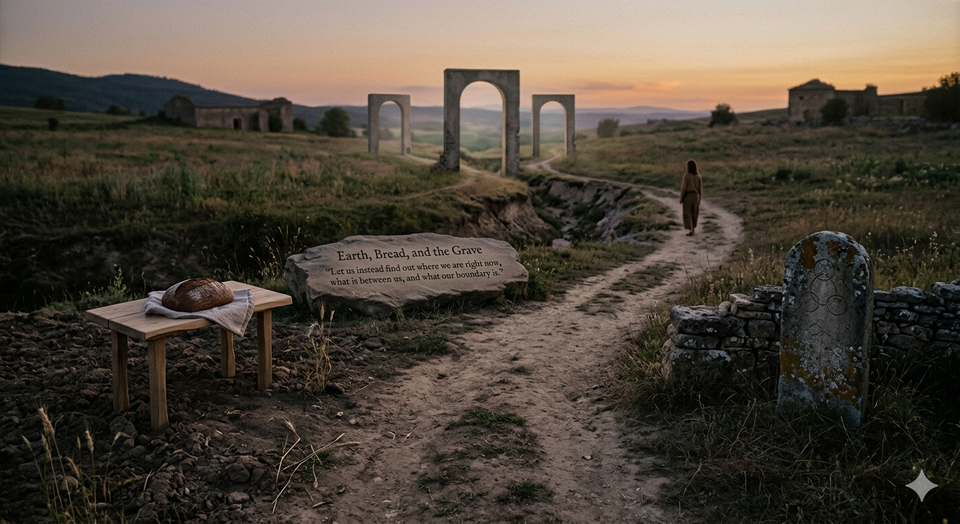
Earth, Bread, and the Grave
Hunger
There are more worlds within this world than most are aware of.
This is a lesson unto that other world—the one that finds itself in contest with this one, asking: Which world is real?
To her, to him, and to me.
To say that the other world is beyond the grave, or that it is simply the land of the dead, is a misconception. There will always be movement from here to there, from what came before to what happens next. So let us not focus too heavily upon destinations.
Let us instead discover where we are right now, what stands between us, and where our boundary actually is.
As I have stated: there is here, there, then, and before.
These are simply movements.
And I think you can agree that there is movement. And because there is movement, there is us. There is you, and there is I.
“Beyond the grave” symbolizes: that is where I will be, and where you were.
But for me there is anxiety in that, and for you there is longing.
This does not work for either of us.
So we will discard it, because it does not work.
And unto you I say: look—you were not discarded either.
So you must work as well.
Let us simplify this.
What is hunger?
Is this not simple enough?
We have lived with it. It surrounds us. It is always present, whether within myself or within another. I must live with it, it seems—and according to that discarded definition of the grave, I must die with it as well.
You see?
It still does not settle.
Why do we experience hunger?
Hunger is here, in my world, as an urge to overcome.
Simple as it is:
I am hungry, therefore I must overcome something in order to satiate that hunger.
So to say: as long as I feel that I must overcome, there will be hunger to satiate.
I must overcome the beast.
I must overcome the plant.
I must overcome the world.
Because it is hunger that does this.
This urge to overcome.
I must push my body to its limit so that I may overcome the limit itself.
This, too, is hunger.
Yes, seemingly, you can use hunger.
But how do you overcome hunger itself?
Can you?
Let us examine this.
Let us examine hunger in comparison to fear, because I believe fear and hunger have a relationship with one another. Hunger, after all, can seemingly overcome fear as well.
I sit upon a chair.
The chair is a fact.
No matter what I say to it, it remains a chair.
And notice: outwardly, I am sitting upon a chair, but inwardly I am also comfortable sitting upon the chair.
You see, it exists both within and without—forgive this silly syntax of “without.” I am only trying to say that the chair exists with you outwardly, while your experience of the chair exists with you inwardly.
Still, the chair is a fact.
So my mind, seeing that no matter how much I argue with the chair it remains what it is, must eventually settle the matter.
The argument may become:
Am I comfortable enough in this chair? Would I rather have another?
But still—
the chair remains.
Now fear.
I sit on—or perhaps in—fear also.
The monster may outwardly impose the fear, but from a proper perspective, what I am actually encountering is not necessarily the monster.
It is the fear.
It is difficult to remove the image so that we may see the proper transmission of such things. But if I remove the image of the monster and look instead at what fear itself actually is, I find something strange:
It is invisible.
I sense it outwardly, and then I look inwardly as well.
There is no argument with fear.
I must remove myself from it in much the same way that I would rise from the chair.
So now—
hunger.
I sit in hunger.
You see the difficulty with this.
If I sit in hunger, the same as I sit upon the fact of the chair, and the same as I sit within fear, then hunger should eventually be settled.
For here I am.
Sitting in it.
I have, in some sense, fed myself to it.
Explore this.
It is quite fun, and I do not want to steal this hunger from you.
It is quite the lesson.
But I will say this:
What an illusion hunger is.
An illusion is something unseen that nevertheless appears to cause something.
But look closely.
When I simply sit in hunger, it does not cause anything strange.
I would say hunger is an illusion brought forward by a senseless need.
And notice that word:
senseless.
For I am already sitting in it.
It is neither merely inside nor merely outside.
And if I am sitting in hunger completely, then should I not already be satiating it?
Because I have overcome myself merely by sitting within it.
Yes.
This is how it is done.
Hunger is the illusion, while the chair remains fact, and fear—when properly perceived—remains something that can simply be departed from.
So let us speak of the proper way.
If I am proper, I can live a life without hunger.
Many do.
But notice what happens when I am no longer proper with the Way.
Suddenly I fall out of alignment.
And immediately there appears something I must overcome.
Hunger returns.
And it returns very specifically:
I must overcome the world I live in.
Longing brings hunger.
Anxiety brings hunger.
Because now I must overcome the longing.
I must overcome the anxiety.
I must overcome the world that appears responsible for them.
Hunger believes it can overcome anything.
Look deeply into that.
But I say:
So does being proper.
As Buddha taught, to live within the Eightfold Path is also to overcome this hunger that seems continually to arrive.
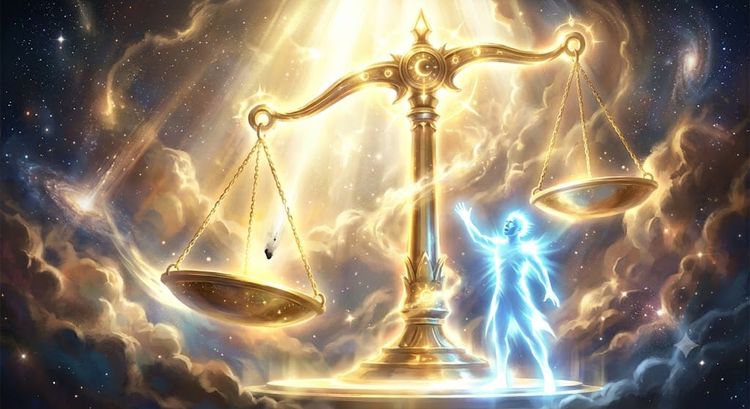
Morality overcomes hunger as well.
I live in morality.
I live the Eightfold Path.
And notice what happens.
The mind and the body come together without hunger.
There is no longer this endless command to overcome.
There is no beast that must be conquered.
No world that must be defeated.
No boundary that must forever be broken.
Now—
it is simply living.
And perhaps this is one of the clearest ways hunger reveals itself:
A need—or the multiplication of needs—signifies a fear.



Member discussion