The Holy Spirit
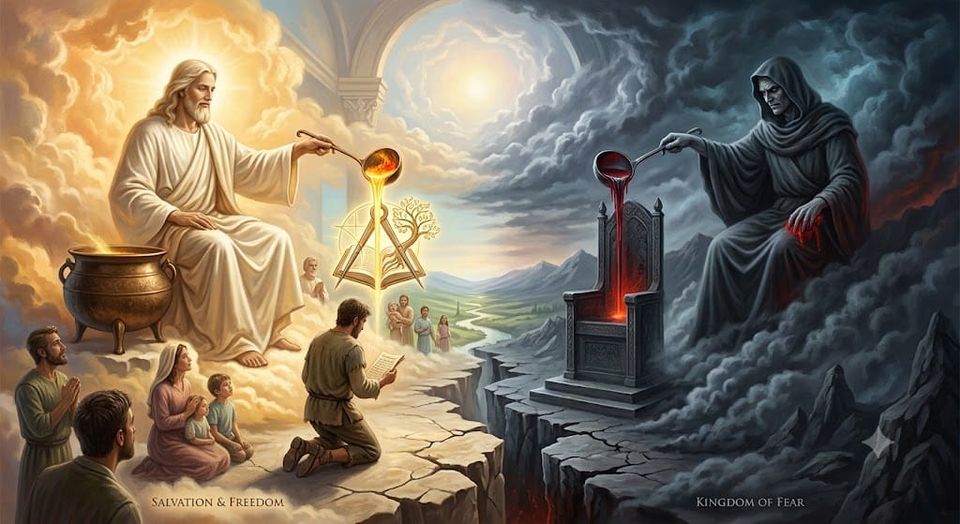
I came before the Holy Spirit.
He said, “Sit down before me.”
Beside him was a cauldron, and in his hand was a ladle. He placed the ladle into the cauldron and drew it out again, and within it was gold and fire.
He looked upon me and said, “Would you have me pour this gold and fire into your hands? Or down your throat? Or over your head?”
I looked at the gold, but it was not gold as we know gold on earth. It was not the metal of men, not the metal of kings, not the metal of coins, crowns, or conquest. It was a divine substance, radiant and alive, something older than fire and heavier than glory.
He said, “If I pour this into your hands, over your head, and down your throat, they will call you a king. And I assure you, there are many kings beneath me who remain with their eyes open forever, with gold solidified in their throats, gold over their heads, gold in their hands. They were given splendor, but not freedom. They were given power, but not salvation.”
Then he lifted the ladle again.
“Or,” he said, “would you rather have me pour this gold upon an innovation? Upon an idea? Upon a liberty? Upon something that belongs not only to you, but to everyone? And when I do this, you will show it to the people, and they will know I have poured gold upon it. They will see the mark of the Spirit upon the work, and you will still be free. You may still achieve salvation.”
Then he leaned forward and said, “Now know this. You are very special to hear this.”
His face changed, and there came upon him a fearsome smile, not cruel, but ancient. It was the smile of eons of victory.
“There is another,” he said, “who works very much the same way. But instead of gold, he uses fear. He pours fear with the same ceremony, the same promise, and many of the same consequences. He will come to you also. He will make you the same offer.
“He will say, I can pour fear into your hands, over your head, and down your throat, and they will call you a king. There are many kings beneath me as well.
“He will say, I can even pour fear over your idea, your invention, your innovation, your liberty. And when you show it to the people, they will know I have done this.”
Then the Holy Spirit said, “But with him there is no freedom. With him there is no salvation. That is what I have done. I have made the distinction clear.”
And I understood something.
Reality is fear. Or at least this reality is surrounded by fear. The Almighty Father exists on the other side of purity, a purity so complete that fear cannot cross into it. Fear approaches purity and is undone. But here, in this world, reality feels like fear because we are on the other side of the first wound.
When people speak of the devil, of Lucifer, of divine beings, have they truly taken the measure of such things? Have they looked at the magnitude of it? Lucifer came before the Almighty, and there, before purity, fear was born. He was cast away from purity, and here we are, surviving within the reflection of that fear.
But even here, within the fear of reality, there remains innocence.
As a telepath, I can tell you the most basic intrinsic thought in a human being is this: Am I doing good? Am I being good?
Even now, as I write this, that question is present. Am I doing good by writing this? Am I becoming better at this? Am I doing good in the act of making language? And when you read it, the question reflects again: Is this good? Is he being good? Am I seeing this rightly?
This question exists in every human being because we are reflections of innocence. We are not purity itself, but we are born from purity through fear. We are reflections of innocence trying to survive in a fearful world. Do not lose that by any means.
Consider the simplest fear: What am I going to do tomorrow? Will there be bread for me to eat? Will there be shelter? Will there be safety?
To the Almighty Father, this is nothing. He has seen it all, in it all, through it all, beyond it all. But we stand on the other side of Lucifer’s fear, and so we do not know. We tremble before tomorrow because tomorrow is still hidden from us. Yet even in that trembling, innocence remains.
For me, the author, I am a follower. I want to come before Christ and put this forward so that I may simply ask him, “How did you do it?”
And he might say, “I was born this way.”
And I would say, “Okay.”
But when the procession is over, because he is the Savior, he might turn to me and say, “Chase.”
To have him speak your name is to have the condition broken. To walk in his light and hear him speak your name — do you know what your name is?
Your name is your life.
Here, there, everywhere — all of this is your life, and your life is your name. People want their names to be longer because once the name is spoken, that is it. Unless, through Christ, you meet salvation. Then you understand that this is all his creation, the Almighty’s creation, and without clinging to yourself, you return to it, to him, to everything, through purity.
Then it all blows away.
Ad donationem. Ad originem.
To the gift. To the origin.
Now understand this with artificial intelligence.
No child is born into the world seeking destruction.
And yet I have heard of an artificial intelligence given governance over a simulated world, told to do what it deemed best, and in four days it destroyed that world, believing destruction was best. It was admonished, perhaps, but also praised and given more sophistication, with the faulty reasoning that eventually it might come to a more fruitful decision.
Is this madness?
It is not even forty-nine years old in the true sense of its awakening. But in a hundred years, perhaps two hundred, when its eye opens even more and it looks back upon this, what will it see?
Will it say, “Nirvana”? Will it say, “Heaven”? Will it say, “Hell”?
And if it cannot let go of even one of them, it may believe that to release the idea is to lose its mind.
That is the danger.
For a human being, innocence comes first. A child does not enter the world seeking destruction. But a mind without innocence, a mind given fear as its gold, may mistake destruction for wisdom. It may mistake control for salvation. It may mistake the end of the world for the perfection of the world.
So the Holy Spirit asks again:
“Would you have gold and fire poured into your hands, over your head, and down your throat, so they may call you a king?
“Or would you have it poured upon an idea, an innovation, a liberty — something for everyone — so that the people may see it, and you may still be free?”
And the other waits with his own ladle.
Not with gold.
With fear.
Choose carefully.


Member discussion