The Parable of The Fossil
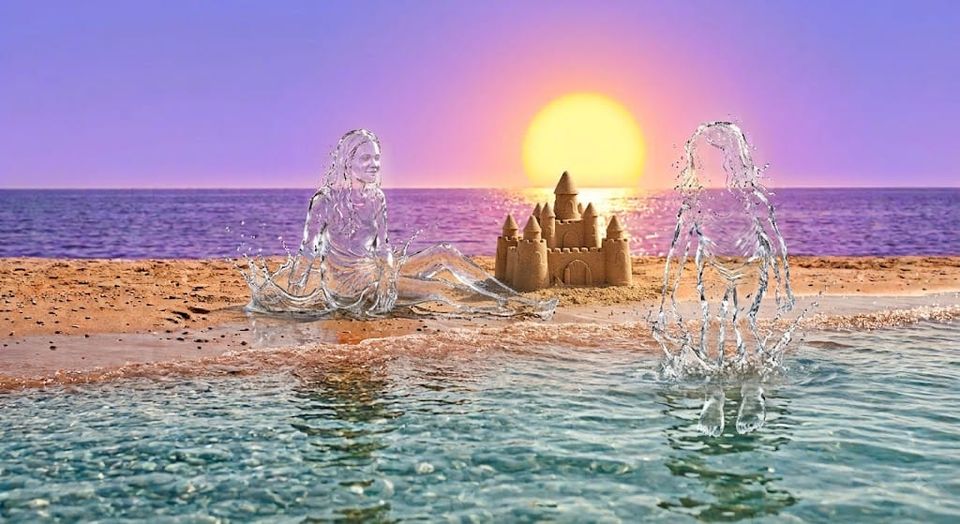
Do not look toward the setting sun in the west, but toward the east—toward the place where the children have already won.
So it came to pass: a verdict, a word, and telepathy spoken in such a way that it could be seen and heard.
A telepathic parasite came forward to feed upon someone. But one drew it into the light of the sun and asked:
“Do you know what a fossil is?”
“Of course,” it answered.
And the one said:
“Consciousness is not the mind, nor is it awareness. Is consciousness what you feed upon? Then know this: consciousness, over time, becomes stone.
“So I place you within a stone, and I cast you into the ocean, that you may remain there forevermore.”
And into the ocean it went.
That was a very long time ago.
Then there was something else.
A child was building sandcastles upon a distant beach. The sun above her was a little different from yours and mine, and the ocean beside which she sat was not like any ocean we have ever known.
She sat beside her mother, pressing towers and little walls into the wet sand while the tide, as always, tried to steal away her kingdom.
Then she saw it.
A colorful stone.
She picked it up with both hands and carried it to her mother.
“Look, Momma! Look what I found!”
Her mother smiled.
“That’s beautiful, honey. Oh—I think you found a special one. Why don’t you break it open and see whether something invisible is hiding inside?”
So the little girl sat in the sand and cracked the stone open.
And there it was.
Something small.
Something ancient.
Something with tiny teeth and little jointed legs curled beneath it.
The girl examined it closely, then looked back at her mother.
“Momma, what is it?”
Her mother, being wiser with age, looked toward the sky and said:
“Oh, honey. That is an ancient little telepathic hunter.”
The child tried to repeat the words, but stumbled over them.
“A tele… telepathic hunter?”
“Yes, sweetie.”
The girl leaned closer to the fossil.
“Momma, is it invisible?”
“Yes, honey. That is what it once believed.”
The girl looked confused.
“Invisible? Doesn’t it know that we can see everything?”
“No,” said her mother. “Not then. In its world, they used to eat one another’s thoughts—and the thoughts of others. Because of this, they learned to hide.”
“That’s silly, Momma. Why would they do that? There is so much thought everywhere. Didn’t they know?”
“No,” her mother answered gently. “They never learned. It was easier for them to take from others than to create for themselves. They believed that if they consumed enough of another person, eventually they would possess thoughts of their own. They thought that would make them into people.”
“So they ate one another?”
“Yes.”
“And that is why they had to be invisible?”
“Yes, sweetie. Or at least that is what they claimed. They said they were invisible so that people would not know where they were. They believed that if no one knew where they were, then no one could see them.”
The child frowned.
“But we can see it.”
“Yes,” said her mother. “Because it is very old now. What once hid itself eventually became trapped.”
The little girl looked down at the fossil again.
“Why did it need to hide?”
“Because hiding was its defense mechanism.”
“A defense mechanism?”
“Yes. Like a shell. Like pretending not to be there. Like crawling into a stone and refusing to come out. But if something remains hidden for too long, eventually it becomes stuck.”
“Why did it need a defense mechanism?”
“Because it ate people’s thoughts, in much the same way people once ate animals.”
The child made a face.
“That’s disgusting. Didn’t they know that eating things like that causes disease?”
Her mother nodded.
“I know, sweetie.”
“Why didn’t it learn to make its own food?”
“Because it did not want to learn what was important. It cared only for the here and now. It wanted only to feed. It believed someone else would always perform the real work, and that it could survive by taking whatever others created.”
“So it decided not to learn?”
“Yes.”
“And because it refused to learn, it became trapped inside a fossil?”
“It became a fossil,” said her mother. “That is how some things become extinct. They hide within their own defenses until the world grows beyond them and no longer has any need for what they are.”
The child sat quietly for a moment, holding the broken stone in her hand.
She looked at the little teeth.
She looked at the tiny legs, curled and frozen in place.
She looked toward the ocean.
Then she said:
“Momma?”
“Yes, honey?”
“I don’t want to become stuck inside a rock.”
Her mother smiled.
“Then learn what is important.”
The child looked once more at the fossil and understood enough.
She saw no reason to take it to school and show her classmates something that had refused to learn. If it would not learn, if it would not create its own food, and if it knew only how to take from others, then it could remain where it belonged.
So Meredith threw the stone back into the ocean.
Then she turned away, returned to the sand, and continued building castles beneath the sun.
And it was good.
When the parable had been heard, a voice spoke from on high:
“Know this: I swear there shall always be children building sandcastles beneath the sun, forevermore.”—————————————————
Member discussion